
2026 Dicamba Update
On February 6, the EPA approved federal registrations for the following dicamba products: Engenia®, Stryax™, and Tavium®. The new registrations are for over-the-top (OTT) use on dicamba-tolerant (DT) soybeans for the 2026 and 2027 growing seasons. Mitigation measures are required to reduce drift, minimize volatility, and protect ecosystems. As in previous years, state specific restrictions will be in place for OTT applications of Engenia®, Stryax™, and Tavium® in Minnesota. (See full MDA press release)
Dicamba is a selective systemic herbicide for post-emergence control of broadleaf weeds. It was first registered by the US Environmental Protection Agency (EPA) in 1967 and is available in several formulations (see table below). Dicamba is registered for use on a variety of food and feed crops, including corn, barley, wheat, and dicamba tolerant (DT) soybeans. It is also used to control weeds in turf including lawns, golf courses, sports fields, and parks.
Prior to 2016, dicamba in soybeans was restricted to only preplant and preharvest applications. However, since then the US EPA approved post-emergence, or over-the-top (OTT) use for specific dicamba products (Engenia®, XtendiMax™, Tavium®) on dicamba-tolerant (DT) soybeans and cotton.
| Pesticide Type | Herbicide (Group 4) |
|---|---|
| Chemical Class | Benzoic Acid |
| Common Trade Names* | Engenia®, Stryax™, and Tavium® |
| Registration Status | EPA: Registered since 1967, new Over-The-Top products are registered until February 6, 2028 MN: Registered |
| Structure |  |
*No endorsement is implied in the referencing of trade names.
Drift, Forms of Dicamba, How it Works, and Use in Minnesota
Dicamba is a highly volatile chemical that can damage non-target plant species through spray drift (particle drift) and/or volatilization (vapor drift). New formulations were designed to reduce volatility. However, since OTT dicamba was registered for use on DT soybeans, the MDA has received complaints for off-site movement onto neighboring property.
Annual Total Reports for Alleged Dicamba Drift
| Year | Number of Reports |
|---|---|
| 2025 | 0 |
| 2024 | 2 |
| 2023 | 15 |
| 2022 | 32 |
| 2021 | 304 |
| 2020 | 128 |
| 2019 | 20 |
| 2018 | 51 |
| 2017 | 249 |
| Dicamba Form | CAS # / PC code | Trade Names* | Soybean OTT Products |
|---|---|---|---|
| Acid | 1918-00-9 029801 | Celius; Vision; Saddle-Up | none |
| Dimethylamine (DMA) salt | 2300-66-5 029802 | Banvel; EndRun; Cimarron Max | none |
| Sodium (Na) salt | 1982-69-0 029806 | Status; Rave; Overdrive | none |
| Potassium (K) salt | 10007-85-9 129043 | Lawn 3iP Herbicide | none |
| Diglycolamine (DGA) salt | 104040-79-1 128931 | Clarity; DiFlexx; Clarifier | Stryax Tavium |
| Bis aminopropyl methylamine (BAPMA) salt | 100094 | Engenia | Engenia |
*No endorsement is implied in the referencing of trade names.
Dicamba is a systemic herbicide that functions as a plant growth regulator. Following application, dicamba is absorbed through leaves and roots of target weeds and is translocated throughout the plant. In the plant, dicamba mimics auxin, a type of plant hormone, and causes abnormal cell division and growth.
Dicamba belongs to the benzoic acid chemical class and is a Site-of-Action 4 herbicide. Other herbicides belonging to Group 4 (synthetic auxins) with a similar mode-of-action include 2,4-D, MCPA, clopyralid, halauxifen-methyl, and aminopyralid.
In Minnesota agriculture, dicamba is used to control weeds in crops including corn, small grain, soybeans, and hay, as well as on fallow cropland, pastures, and land enrolled in conservation reserve programs. In 2016, Minnesota registered three new dicamba products (XtendiMax, Engenia, and FeXapan) for OTT application to DT soybeans to control broadleaf weeds such as pigweeds (Amaranthus spp.), ragweeds (Ambrosia spp.), horseweed (Conyza spp.), and Kochia spp. Prior to 2016, dicamba was registered for pre-plant and pre-emergence applications in conventional soybeans, Roundup Ready soybeans, and Liberty Link soybeans. New DT soybeans are tolerant to dicamba and glyphosate herbicides.
In 2017, the MDA received 249 complaints of off-site dicamba damage. To curb off-site movement, the MDA set June 20 as the annual application cutoff date for registered dicamba products from 2018 to 2020. This date was based on research and pesticide misuse complaints. In October 2020, EPA set June 30 as the application cutoff date on federal labels for OTT dicamba applications to DT soybeans. In 2022, the MDA worked with the U.S. Environmental Protection Agency (EPA) and the registrants of the three dicamba products to include the date and temperature cutoff restrictions on the product labels. On February 6, 2024, the U.S. District Court of Arizona vacated the 2020 federal registrations of OTT dicamba products for soybeans, XtendiMax® (EPA Reg. No. 264-1210), Engenia® (EPA Reg. No. 7969-472), and Tavium® (EPA Reg. No. 100-1623), making their sale or distribution illegal in the United States after June 12, 2024. As a result of the court decision, OTT dicamba products were no longer registered for use in Minnesota in 2025.
Following the 2024 court ruling, the pesticide registrants submitted new product proposals that include OTT application of dicamba on DT soybeans. The revised labels proposed new use patterns and stricter restrictions, including reduced application rates and limited over-the-top use in soybeans, aimed at reducing off-target movement and preventing crop damage. On February 6, 2026, three dicamba products, Engenia® (EPA Reg. No. 7969-507, BASF), Stryax™ (EPA Reg. No. 264-1241, Bayer), and Tavium® Plus VaporGrip Technology (EPA Reg. No. 100-1753, Syngenta) received federal registration and subsequently were registered for use in Minnesota. These products are approved for use on DT soybeans and DT cotton only.
Non-agricultural applications of dicamba include uses on residential lawns and on golf course turf throughout the state. Engenia®, Stryax™, and Tavium® are not approved for these uses.
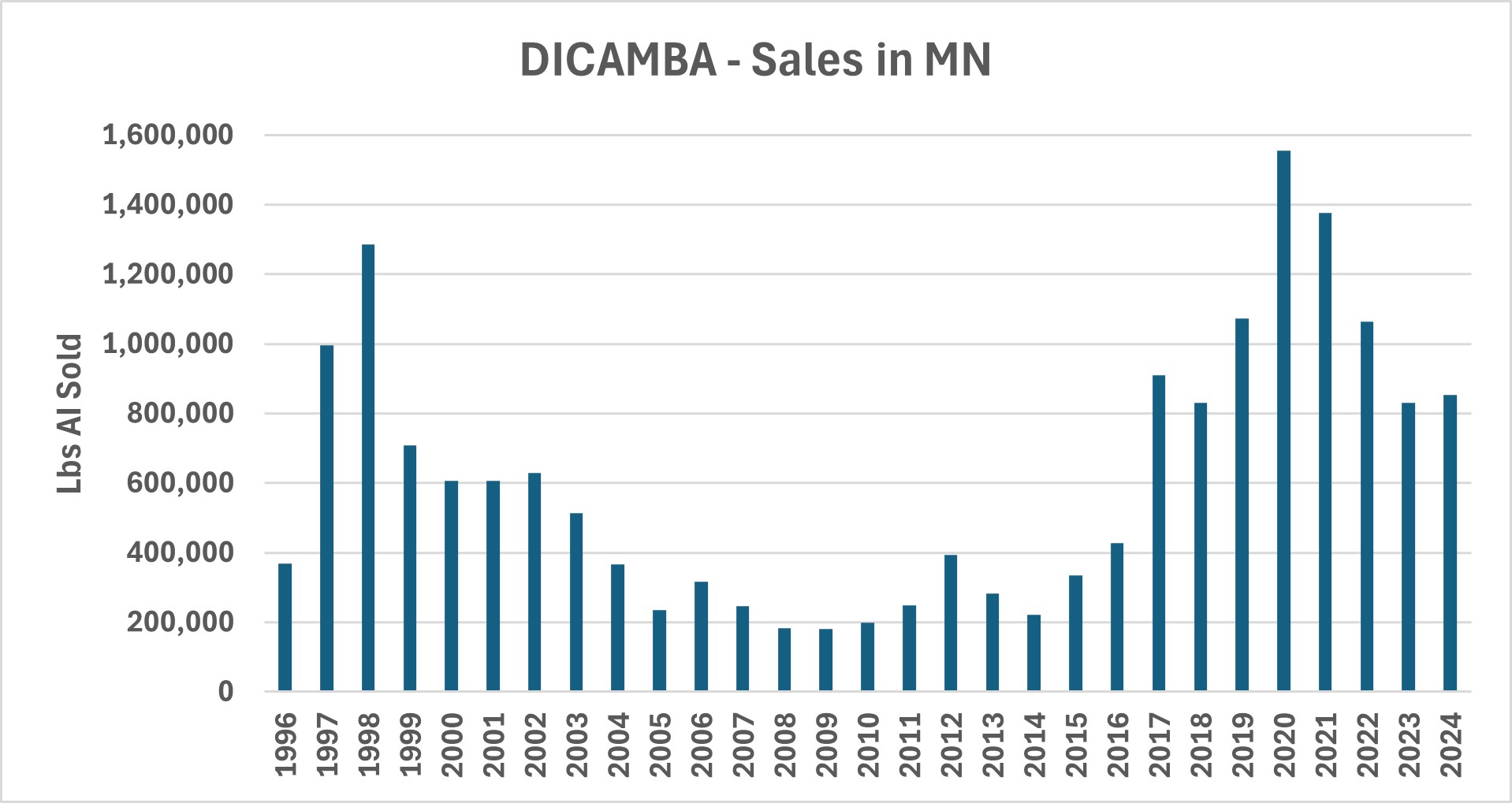
The MDA tracks the sale of pesticide active ingredients in the state. The graph below shows annual dicamba sales in Minnesota between 1996 and 2024. Dicamba sales data are pooled for all forms of dicamba and reported as the pounds of dicamba acid equivalents (a.e.) sold. Sales data are available through the Pesticide Sales database.
Toxicity
The various salts of dicamba are considered to have a similar toxicity to dicamba acid. Furthermore, Dicamba salts are rapidly transformed into the acid form in the environment. Therefore, toxicity information is listed for dicamba acid.
Dicamba has a low acute toxicity via oral, dermal, and inhalation routes. It is an eye and dermal irritant, but it is not a skin sensitizer.
Human Health Values for Dicamba Acid. Data from US EPA1 and the Minnesota Department of Health (MDH).
| Population Adjusted Dose (PAD) | Acute=0.29 mg/kg/day Chronic=0.04 mg/kg/day |
|---|---|
| Cancer Effect | Not likely to be carcinogenic to humans |
| MDH Health Risk Limit (HRL) (chronic, 1993) | 200 µg ae/L |
Dicamba toxicity is low for aquatic organisms, mammals, and honeybees, and it is moderately toxic to birds. Non-target plants exposed to dicamba may be damaged by this herbicide.
Dicamba acid toxicity values for aquatic and terrestrial organisms. Data from US EPA2
| Aquatic Organism | Toxicity Values | Toxicity Level |
|---|---|---|
| Freshwater fish | Acute LC50 = 28 mg ae/L Chronic NOAEC = N/A | Slightly toxic |
| Freshwater invertebrates | Acute EC50 > 50 mg ae/L Chronic NOAEC = No data | Practically non-toxic |
| Aquatic plants | Vascular EC50 = N/A Nonvascular EC50 = 0.493 mg ae/L | |
| Most Sensitive Aquatic Life Benchmark (ALB)* | 61 µg/L (nonvascular plants) |
| Terrestrial Organism | Toxicity Values | Toxicity Level |
|---|---|---|
| Mammals | Acute oral LD50 = 2,740 mg ae/L Chronic NOAEC = N/A | Practically non-toxic |
| Birds | Acute oral LC50 = 188 mg ae/L | Moderately toxic |
| Honey bee | Acute contact LD50 > 90.65 µg ae/bee | Practically non-toxic |
*ALB value based on toxicity data from US EPA3.
Dicamba in the Environment
Dicamba is quickly biodegraded in soil under aerobic conditions (with oxygen) but is more persistent under anaerobic conditions (without oxygen). It is not likely to leach to groundwater due to its fast degradation; however, dicamba may reach surface water via run-off, spray drift during application, or vapor drift. Vapor drift from the volatilization of dicamba can result in injury of nearby non-target plants.
Dicamba salts are rapidly transformed into the acid form in the environment; therefore, properties are listed for dicamba acid.
| Water Solubility | 6100 mg/L |
|---|---|
| Dissociation Constant | pKa = 1.9 |
| Adsorption | Koc = 3.45 - 21.1 mL/goc (mean = 13.4) |
|---|---|
| Soil Metabolism | Aerobic half-life = 18 days Anaerobic half-life = no data |
| Photolysis | no data |
| Aquatic Metabolism | Aerobic half-life = 72.9 days Anaerobic half-life = 423 days |
|---|---|
| Photolysis | Half-life = 105 days |
| Hydrolysis | Stable |
| Volatilization | Vapor pressure (25°C) = 3.41 x 10⁻⁵ torr Henry's Law constant = 1.79 x 10⁻⁸ atm m3/mol |
|---|
3,6-dichlorosalicylic acid (DCSA) is the major degradate, or breakdown product, of dicamba. Because DCSA is primarily formed in plants, the EPA does not expect DCSA to reach groundwater at levels that would be of concern. However, DCSA is more toxic than the parent compound to certain species of birds and mammals; thus, there could be potential for adverse effects to certain species of birds and mammals. Mitigations are imposed on registration to alleviate these risks. Other minor degradates of dicamba include 3, 6-dichlorogentisic acid (DCGA) and 5-OH-dicamba.
Dicamba product labels include environmental hazard statements and language may vary among products. See individual product labels for full list of environmental hazards and spray drift management restrictions or recommendations. Always read the label before applying a pesticide.
References
- US EPA Dicamba and Dicamba BAPMA Salt: Human-Health Risk Assessment for Proposed Section 3 New Uses on Dicamba-tolerant Cotton and Soybean (2016). [Docket ID: EPA-HQ-OPP-2016-0223-0002]
- US EPA Problem Formulation for the Environmental Fate, Ecological Risk, and Drinking Water Assessments in Support of the Registration Review of Dicamba (2016). [Docket ID: EPA-HQ-OPP-2016-0223-0004]
- US EPA Ecological Risk Assessment for Dicamba DGA Salt and its degradate, 3,6-dichlorosalicylic acid (DSCA), for the Proposed Post-Emergence New Use on Dicamba-Tolerant Cotton (2016). [Docket ID: EPA-HQ-OPP-2016-0187-0005]

