
-
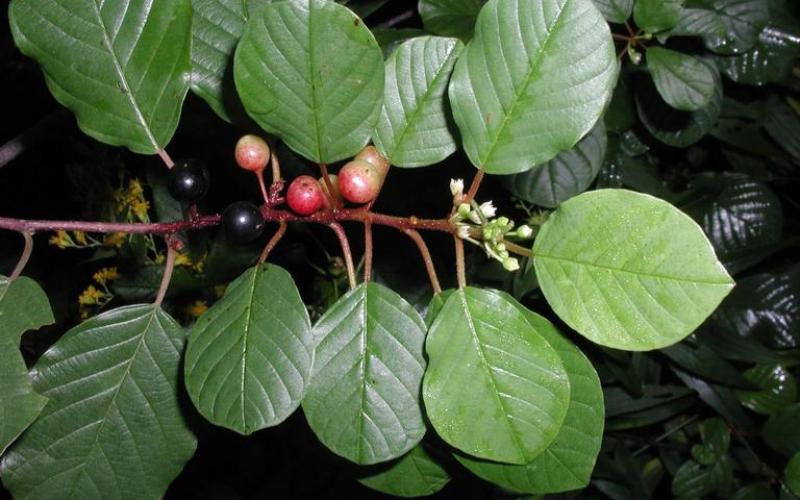 Leaves stay green late into the fall after most other trees have shed their leaf canopy, making glossy buckthorn easy to identify at this time of the year.
 -
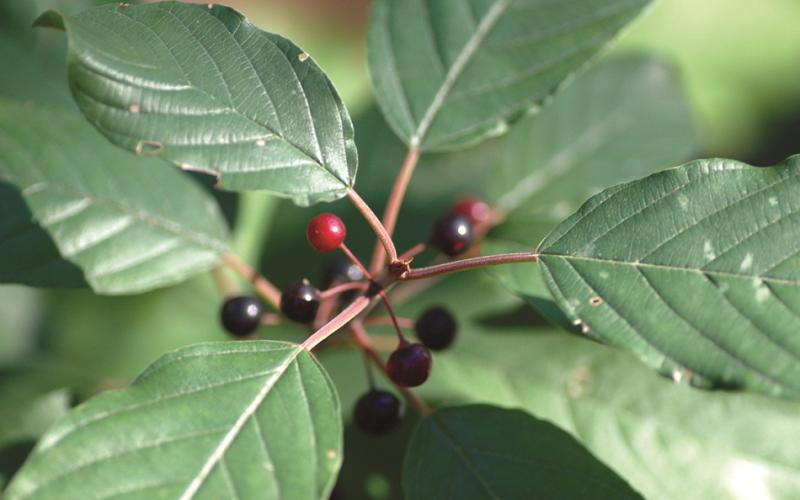 Round berries are produced following fertilization and ripen in August and September, transitioning from green to red early in development and then red to dark purple when ripened.
 -
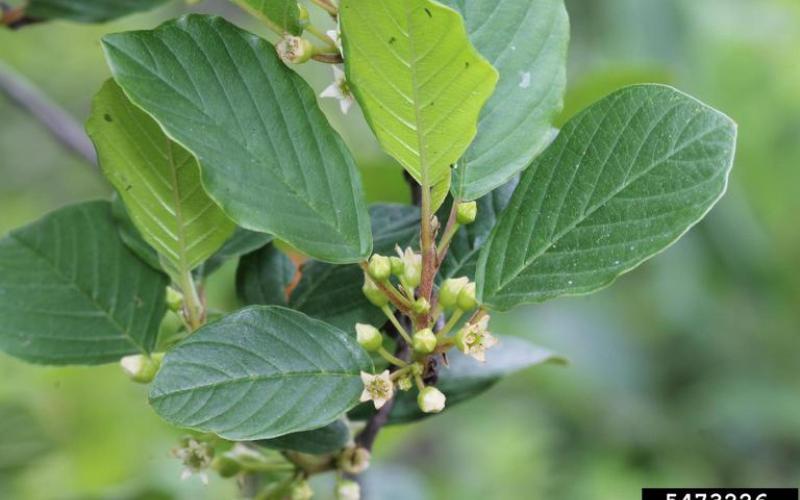 Small, greenish-white, five-petaled flowers are produced in clusters near the base of the leaf stalks along the branches.
 -
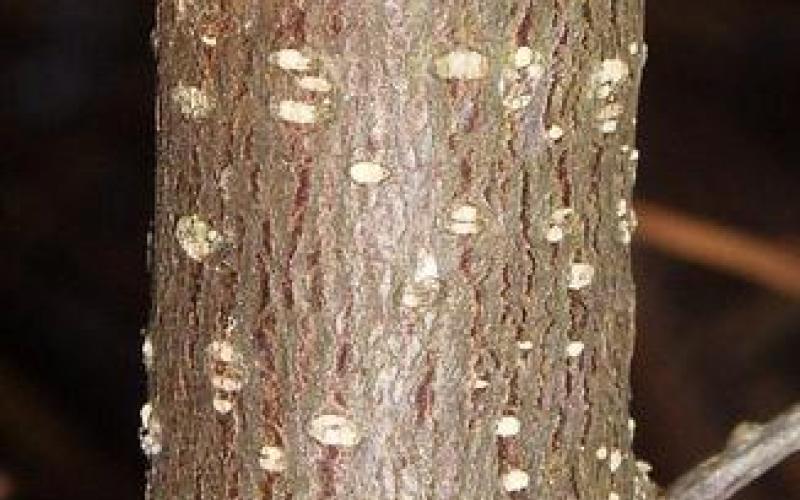 Main stem can be up to 10 inches in diameter with brown bark and has elongate silvery corky projections.
 -
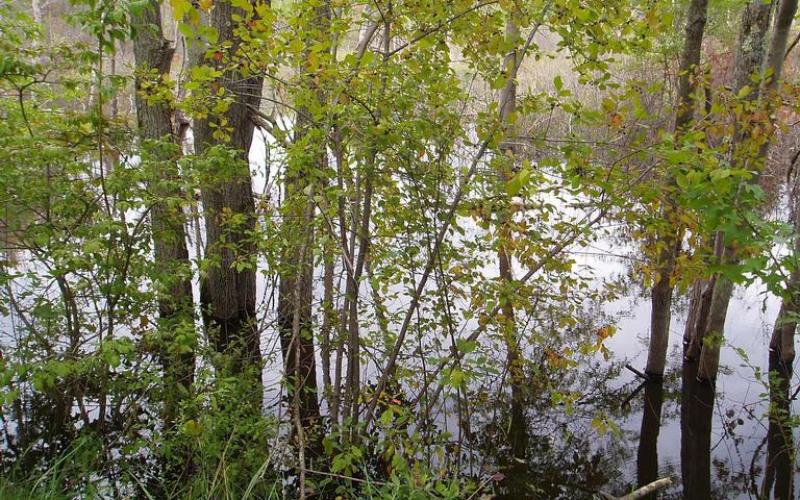 Glossy buckthorn occurs in a variety of upland forested habitats, but prefers sunny moist sites.
 -
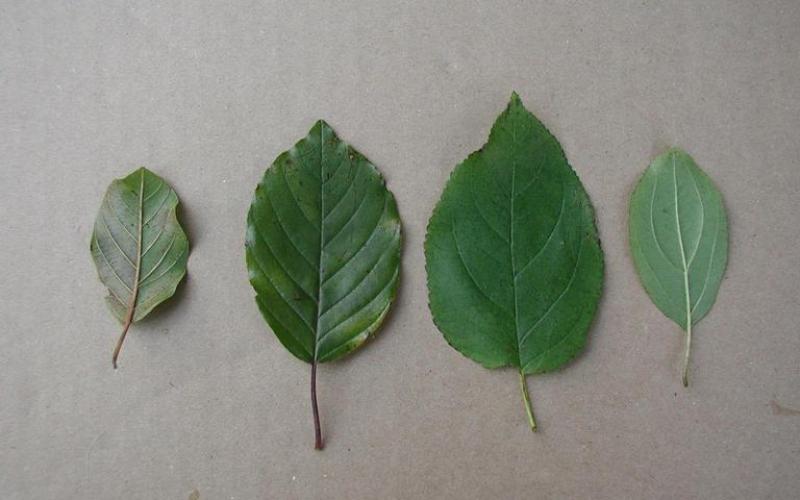 Leaves can vary in size.
 -
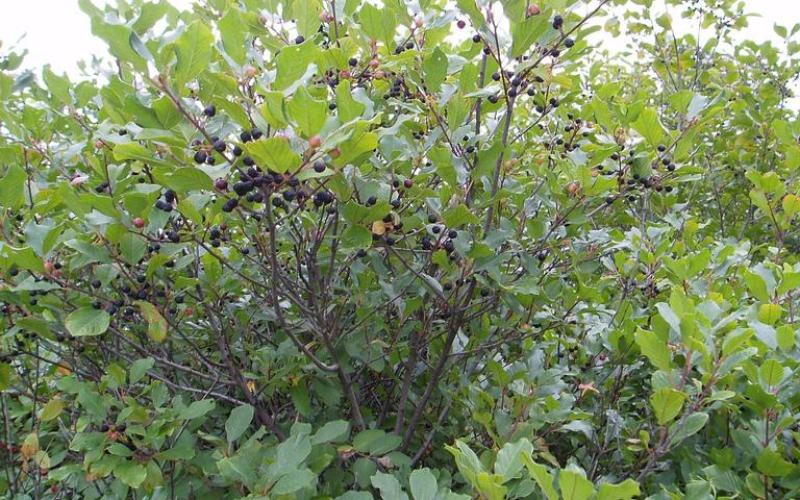 Berry clusters are typically a mixture of ripened and unripened fruits and are highly attractive to birds, facilitating quick spread into new areas.
 -
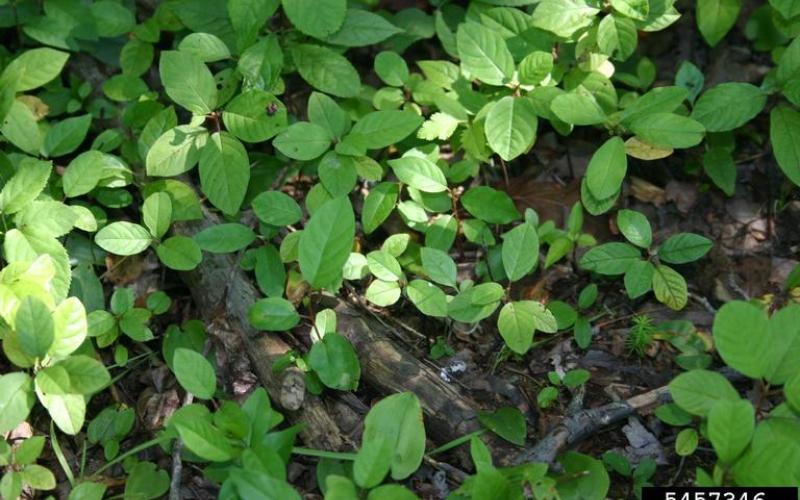 Ripened berries drop directly beneath the plants, resulting in a dense understory of seedlings.
Common Name: Glossy buckthorn
Alternate Name: Alder buckthorn, columnar buckthorn, fernleaf buckthorn, tallhedge buckthorn
Scientific Name: Frangula alnus Mill. and all cultivars
Synonyms: Rhamnus frangula L., Rhamnus frangula L. var. angustifolia Loudon, Rhamnus frangula L. ssp. columnaris hort.
Related Species: Common/European buckthorn (Rhamnus cathartica L.)
Legal Status
Propagation and sale of this plant and its cultivars are prohibited in Minnesota. Transportation is only allowed when in compliance with Minnesota Statute 18.82. Although Restricted Noxious Weeds are not required to be controlled or eradicated by law, landowners are strongly encouraged to manage these invasive plants on their properties in order to reduce spread into new areas.
Background
Glossy buckthorn is native to Europe and Asia. It is a highly invasive perennial understory shrub or a small tree that can grow 15 to 20 feet tall and up to 10 inches in diameter. It was introduced to North America as an ornamental shrub and used for living fence rows and wildlife habitat. Since its introduction, it has spread aggressively across much of the Northeast and Upper Midwest.
Gossy buckthorn has become a serious threat to the degradation of native forest understory habitats where it outcompetes native plant species especially in wet meadows and other moist soil environments.
Description
- Glossy buckthorn is a tall understory shrub or small tree with a spreading or branched crown. Young plants have multiple stems at the base; mature plants eventually develop a singular trunk.
- Main stem can be up to 10 inches in diameter with brown bark and has elongated, silvery corky projections. Cut stems have orange heartwood (center/non-living) and yellow sapwood (outer/living part of stem).
- Branches contain buds and leaves that alternate along the stem. Twigs do not produce terminal thorns like common buckthorn.
- Leaves are oval, smooth, glossy, toothless. Leaves have 8 to 9 veins that radiate outward from a central mid-vein. Leaves remain green late into the fall after most other trees have shed their leaf canopy, making glossy buckthorn easy to identify at this time of the year.
- Small, greenish-white flowers with five petals form in clusters near the base of the leaf stalks along the branches. Flowers contain both male and female parts.
- Round berries are produced following fertilization and ripen in August and September. Berries contain 3 to 4 seeds, change from green to red early in development and then red to dark purple when ripened. Berry clusters are typically a mixture of ripened and unripe fruits and are highly attractive to birds, facilitating quick spread into new areas.
- Common buckthorn looks similar except branches terminate in sharp thorns (1/4 inch), leaves are mostly opposite, egg-shaped, finely toothed, and pointed, with 3 to 5 distinctive curved veins that extend from the leaf stalk to the tip. Plants are either male or female, and berries tend to ripen to a dark black color, usually maturing at the same time.
Habitat
Glossy buckthorn occurs in a variety of upland forested habitats but prefers sunny moist sites. It is typically found in forest understories, hedgerows, bogs, stream and lake edges, wetland boarders, wet meadows, urban landscapes, roadsides, and other disturbed habitats. Although not as widely distributed as common buckthorn, this species is currently found throughout Minnesota with the highest densities in forested and urban regions of east-central and southeastern regions of the state.
Glossy buckthorn continues to spread throughout Minnesota; therefore, landowners and managers should be aware of this species and eradicate any new populations. Glossy buckthorn cultivars are still legally sold in the nursery trade in states outside of Minnesota. Therefore, occasionally national distributors may mistakenly send glossy buckthorn cultivars to Minnesota nursery dealers. Minnesota nursery managers and landowners should be aware of what they are purchasing and contact the MDA if glossy buckthorn or any of the following cultivars are discovered for sale in the state: 'Columnaris', 'Aspenifolia', or 'Ron Williams'.
Means of spread and distribution
Ripened berries drop directly beneath the plants, resulting in a dense understory of seedlings. The fruits are also highly attractive to birds and small mammals, aiding in the spread of seeds to new areas, sometimes several miles from the initial infestation. Due to the spread of seeds via birds, glossy buckthorn is extremely hard to control and eradicate.
Impact
Glossy buckthorn is a serious threat to riparian, wetland, bog, and meadow habitats in Minnesota. It can also thrive in a variety of upland landscapes including forested regions where it forms dense, even-aged stands that crowd out native understory species and often completely displaces understory habitats. These thick infestations also prevent the natural regeneration of forest tree and shrub species. Glossy buckthorn is also a concern to agricultural producers because it can serve as an alternate host for alfalfa mosaic virus, oat crown rust and soybean aphid.
Prevention and Management
- A sound management plan is necessary to manage this species and will take a commitment of many years to ensure that the population has been eliminated or at least under control. Landowners that work together with their adjacent neighbors and local governments to develop a long-term regional management plan have the greatest success reducing this species over time. Management plans that emphasize native species restoration following treatments have been shown to sustain management well into the future and prevent new populations from developing. New infestations are less costly to control and easier to eradicate. Once glossy buckthorn becomes well-established on a property, it is expensive to control and requires a significant amount of labor. Landowners that live adjacent to or near established glossy buckthorn populations should continually be on the lookout to eradicate seedlings sprouting on properties.
- Uprooting small diameter glossy buckthorn plants (about ½ inch- 1 ½ inch in diameter) using a root extractor or similar tool can be effective on smaller stands. However, it is IMPORTANT to reduce any disturbance to the soil during this process otherwise new buckthorn seedlings or other invasive plants like garlic mustard will develop in those disturbed areas.
- Early spring-controlled burns in fire-adapted natural areas can be a useful approach to controlling glossy buckthorn seedlings in forests and woodlots with dense populations. Prescribed burns can also be effective on infestations in wetlands, meadows and bogs during the dry season. Burning annually or every other year on well-established infestations may be necessary to significantly reduce glossy buckthorn density and regeneration. Fire is not a standalone management option and usually works best in conjunction with herbicide applications and uprooting strategies. Make sure to contact the Minnesota Department of Natural Resources to learn more about control burning practices and regulations.
- Foliar stem injection, basal bark, and cut-stem application of herbicides that translocate their active ingredients into the root system can be very effective. Foliar treatments work best on seedlings and immature plants and should be applied early in the growing season. Stem injections, basal bark and cut-stem treatments work better on mature plants and can be applied during late fall when glossy buckthorn is easy to identify (green leaves are still on the plants after other trees are bare) and other forest understory or wetland plants have gone dormant. Treatments will need to be administered for several growing seasons until the population is eliminated or under control. If using herbicide treatments, check with your local University of Minnesota Extension agent, co-op, or certified landscape care expert for assistance and recommendations. There are several businesses throughout the state with certified herbicide applicators that can be hired to perform chemical applications. Glossy buckthorn is commonly found in or around riparian and wetland habitats. If treating plants near water with herbicide, please be aware of the state pesticide laws and use only products labeled for aquatic use.
- Glossy buckthorn lifecycle and treatment timing graphic

