
-
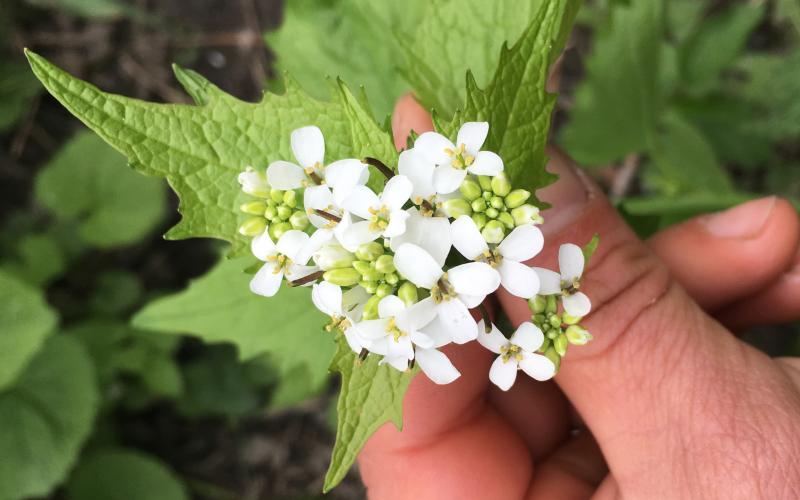 Small clusters of white four petaled flowers bloom in early summer.
 -
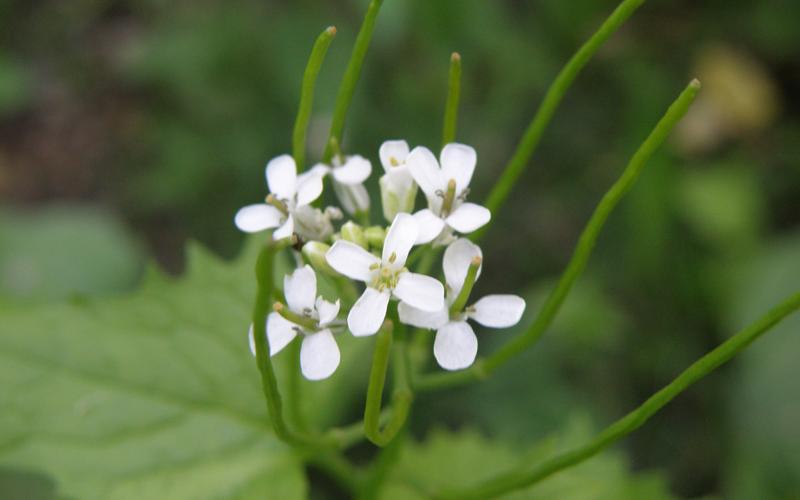 Small clusters of white four petaled flowers bloom in early summer.
 -
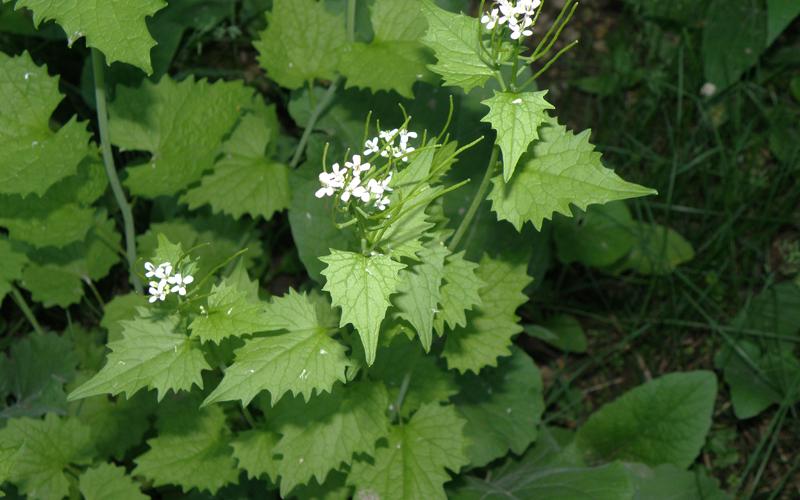 Garlic mustard bolts in its second year and can grow up to 4 feet tall.
 -
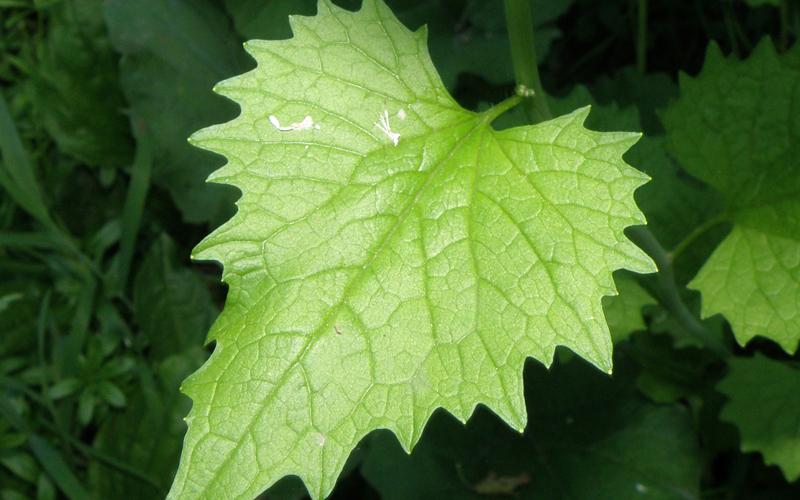 Upper leaves are triangular while lower leaves are heart-shaped.
 -
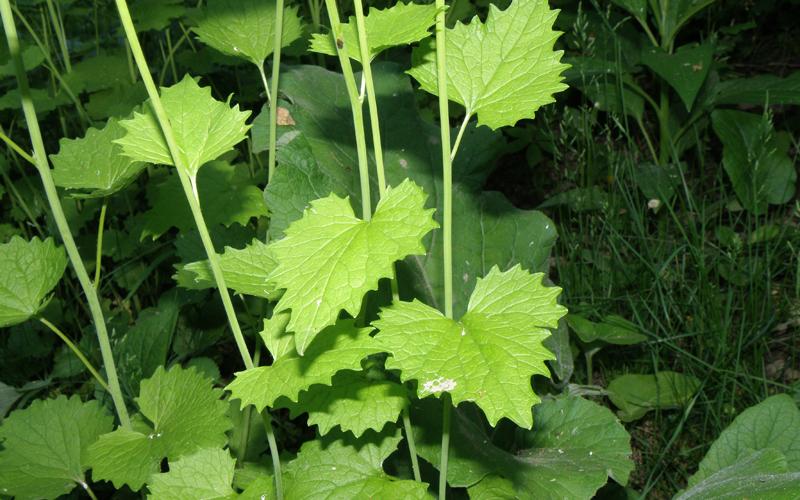 Garlic mustard bolts in its second year and can grow up to 4 feet tall.
 -
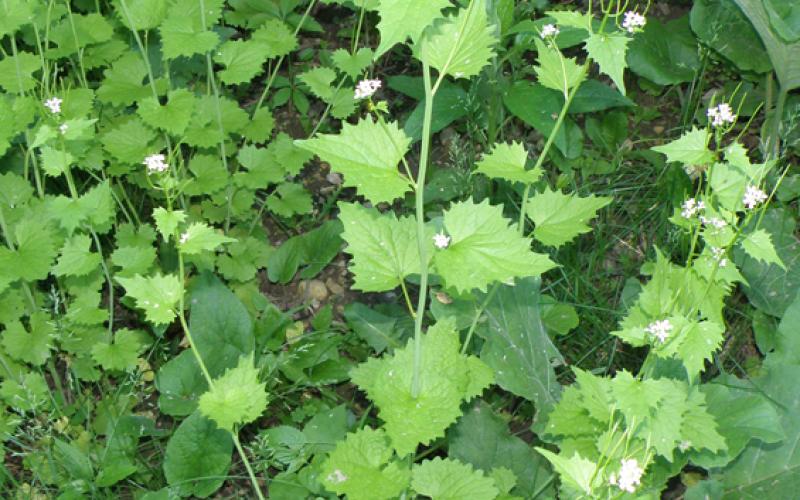 Scalloped leaves alternate along erect stems.
 -
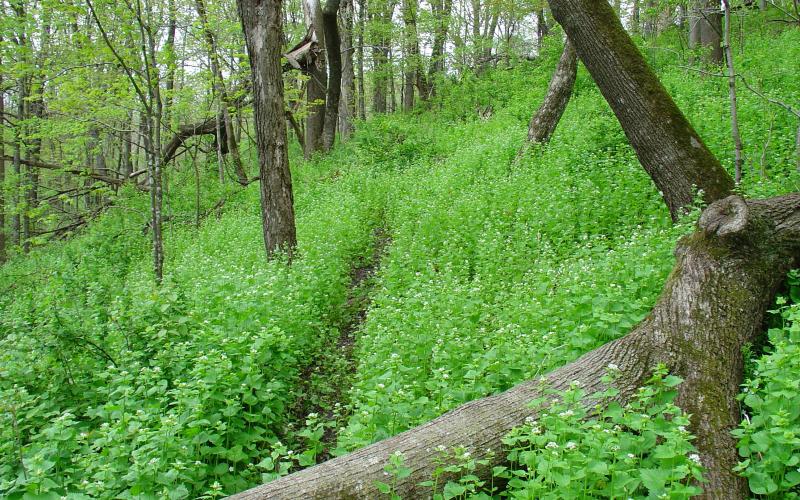 Garlic mustard forms dense infestations in woodland understory.
 -
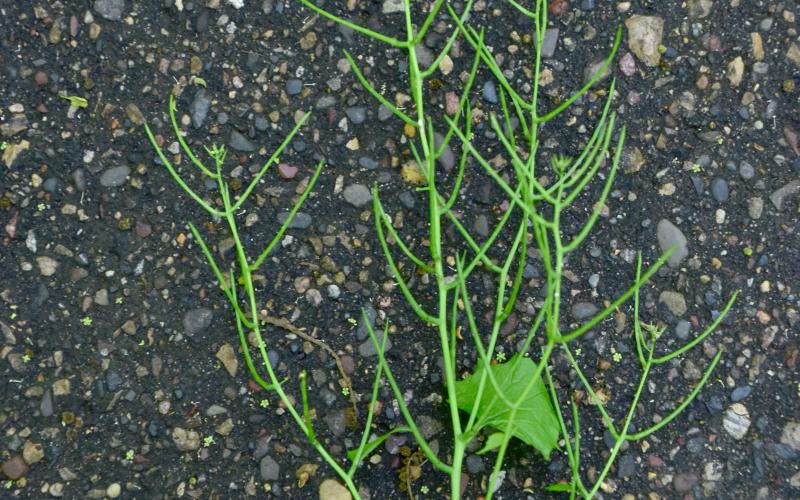 Garlic mustard seed pods form in summer and contain multiple small black seeds.
Common Name: Garlic mustard
Scientific Name: Alliaria petiolata (M. Bieb.) Cavara & Grande
Legal Status
Propagation and sale of this plant are prohibited in Minnesota. Transportation is only allowed when in compliance with Minnesota Statute 18.82. Although Restricted Noxious Weeds are not required by law to be controlled or eradicated, landowners are strongly encouraged to manage these invasive plants on their properties in order to reduce spread into new areas.
Background
Garlic mustard is native to Europe. It was first brought to New York state in the 1800s, mostly likely for food or medicinal purposes. It is now widespread across the eastern and Midwestern United States.
Description
- Garlic mustard is an early season biennial herb that germinates from seed, forms a rosette in the first year, bolts into a mature flowering stem the second year, produces seed and dies.
- Emits a strong garlic odor when plant parts are crushed.
- Grows 1 to 4 feet tall.
- Leaves are coarsely toothed and alternate along erect stems; upper leaves are triangular while lower leaves are heart shaped.
- Small white flowers with four petals form in clusters at the top of stems.
- Flowering occurs from May through June.
- Slender seed capsules (1 to 2.5 inches long) form at the top of stems after flowering and produce a single row of oblong black seeds.
- This species reproduces only by seed.
Habitat
Garlic mustard invades upland woodlands and floodplain forests. It is commonly found along roadsides, trails, forest edges and waterways. It thrives in a wide range of light and soil conditions. It is often associated with calcareous (lime rich) soils and does not tolerate highly acidic soils.
Means of spread and distribution
Garlic mustard spreads by seeds. It is prevalent through the southern half of Minnesota and continues to spread north.
Impact
Garlic mustard is highly invasive and detrimental to forest understory health and biological diversity. Native understory plants have a hard time competing with invading garlic mustard populations. It can spread into high quality woodland habitats, not just into disturbed areas.
Prevention and management
- A sound management plan for garlic mustard will take a commitment of several years to ensure that the population has decreased significantly and is not a serious problem. Focus should be placed on preventing the flowering of populations, which means that timing of management in the fall to reduce overwintering rosettes and during early spring to eliminate flowering stems is critical for success.
- Persistent hand-pulling may be practical on small patches. It is important to pull plants prior to flowering to prevent seed production. Flowering plants can continue to produce seed for a few days following removal from soil. Plants that are already flowering when pulled will need to be bagged. Regular site check-ups for several years will be required to ensure that new seedlings are destroyed, and the seed bank is exhausted.
- Mowing and cutting plants in forested situations is not always practical. However, weed trimmers can be used within wooded areas to cut early bolting plants prior to flowering in May. Plants along roadsides, trails, wood edges, and waterways can also be mowed or cut during the same time period. All equipment should be inspected and cleaned prior to moving into new areas where garlic mustard is not established to prevent movement of seed.
- Specific chemical applications have been shown to be successful when applied in the early spring prior to flowering and in the late fall on overwintering rosettes. Late fall applications can be applied on green overwintering rosettes after other forest understory plants are dormant, thus reducing non-target risks. Early spring applications should consist of spot-spraying specific plants to avoid non-target impacts. If you plan to use herbicide treatments, check with your local University of Minnesota extension agent, co-op, or landscape care expert for assistance and recommendations. There are several businesses throughout the state with state-certified herbicide applicators that can be hired to perform chemical applications for common tansy and other noxious weed species.
- Garlic mustard lifecycle and treatment timing graphic

