
-
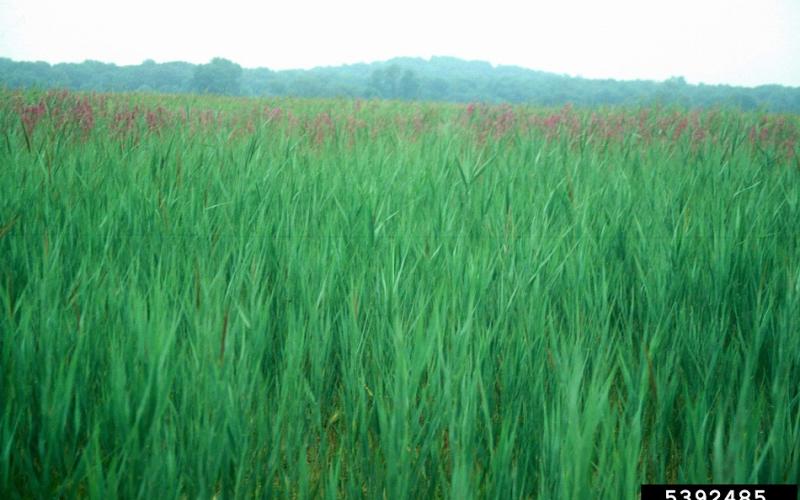 An infestation in a rural area.
 -
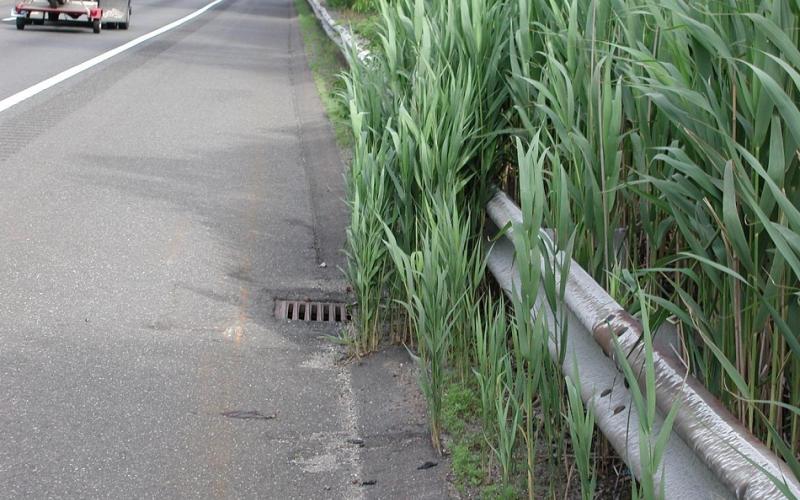 Non-native phragmites can grow through asphalt and cause damage to roadways.
 -
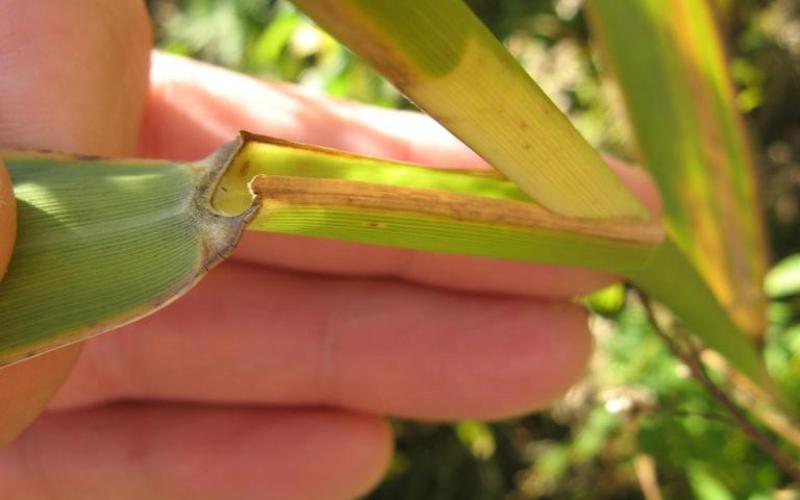 Leaves adhere tightly to the stem throughout the growing season.
 -
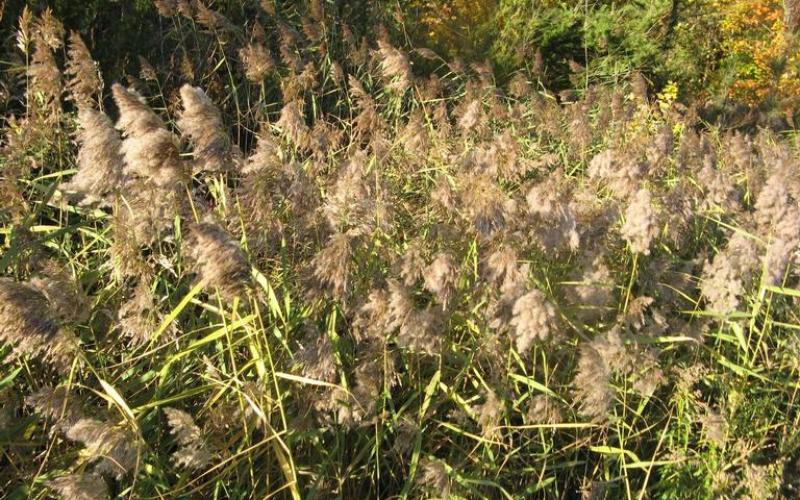 Flowers develop in early August at the tip of each stem and form dense feathery panicles that are typically purple (early development) to golden (late season/winter) in color.
 -
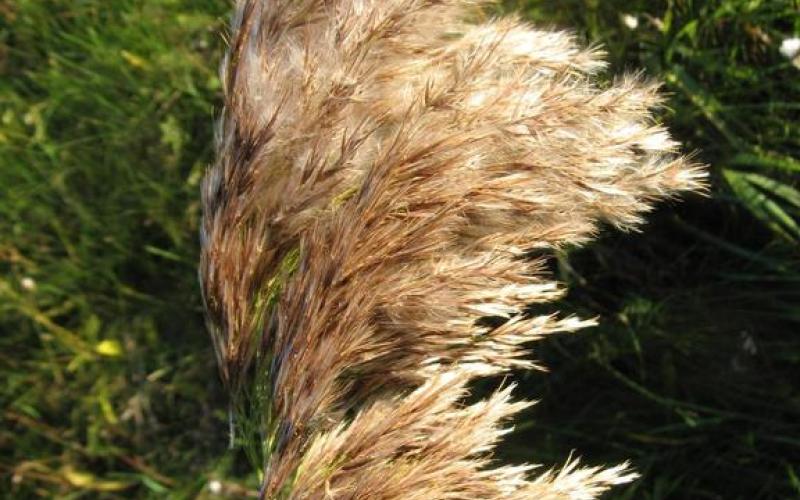 Flowering stalks produce thousands of grayish seeds covered in fine silky hairs that give them a fluffy appearance.
Common Name: Non-native Phragmites
Alternate Names: Invasive giant reed, invasive giant reedgrass, invasive Phragmites
Scientific Name: Phragmites australis subspecies australis (Cav.) Trin. ex Steud.
Similar Species: Native common reed - Phragmites australis (Cav.) Trin. ex Steud.
Legal Status
Efforts must be made to prevent seed maturation and dispersal of plants into new areas. Additionally, no transportation, propagation, or sale of these plants is allowed. Failure to comply may result in enforcement action by the county or local municipality.
Waste water treatment facilities (WWTF) with established reed beds prior to February 1, 2021, that are adhering to state approved best management practices for facilities and transporting biosolids, with the ultimate goal of enacting a phase out of non-native Phragmites if alternative wastewater treatment options can be found, are exempt from controlling non-native Phragmites in the reed beds.
WWTF should contact their County Ag Inspector to obtain a transport permit.
Background
There are two varieties of Phragmites australis in Minnesota. The first is the variety native to North America that is not invasive. The second is an introduced variety (subspecies australis - A.K.A. invasive common reed) that has been shown to be very aggressive and is responsible for displacing populations of native common reed throughout the United States, including Minnesota.
This semi-aquatic perennial grass species was first introduced to North America in the 1700s or early 1800s along the eastern seaboard. During the 20th century, it spread across the entire continent, invading wetlands, lake shores, streambanks and marshy areas. Both the native and invasive varieties look similar, and it takes some familiarity to learn the differences between both plants.
Description
- Non-native phragmites is a warm season, perennial, semi-aquatic grass species that can grow up to 15 feet tall. It forms dense clonal stands containing both living and dead shoots from previous growing seasons.
- Stems are hollow, ridged, and rough in texture. Stems typically lack fungal spots and red internodes (features commonly found on native variety stems). They are green with yellow nodes during the growing season and turn tan or yellow when dry during the winter.
- Leaves are blue-green, 15 to 20 inches long, 1 to 1.5 inches wide. Leaves are arranged along one side of the stem. Leaves remain attached to the stem throughout the growing season as long as the stalk stands.
- Flowers develop in early August at the tip of each stem and form dense feathery panicles that are typically purple (early development) to golden (late season/winter) in color.
- Flowering stalks produce thousands of grayish seeds covered in fine silky hairs, giving them a fluffy appearance.
- Below ground, root growth is extensive. Roots and rhizomes can spread more than 10 feet laterally and several feet deep in a single growing season.
- It is IMPORTANT that the differences between the native species and non-native subspecies are clearly identified before deeming a site infested by invasive common reed. Several online resources are available that provide comparisons of both plants. Please visit the U of M's Identifying and Reporting Invasive Phragmites webpage or Michigan State University Extension information to learn the differences.
Habitat
Non-native phragmites grows in a variety of aquatic to semi-aquatic habitats throughout the state. This plant is commonly found in disturbed sites where soil has been exposed or nutrient inputs are high such as roadsides, gravel pits, developed shorelines, disturbed wetlands and marshes, flooded areas, eroded streambanks, etc.
Means of spread and distribution
Non-native phragmites spreads to new areas through both seeds and vegetative means. Vegetative dispersal typically occurs through the movement of root fragments through eroded streams or contaminated soils. Seed dispersal occurs by wind, water, animal and human activities. Existing stands spread horizontally through a vast network of underground rhizomes, which can grow up to 10 feet in a single growing season.
Impacts
Non-native phragmites spreads aggressively by producing large numbers of seeds and an extensive system of rhizomes. This growth allows it to outcompete native plant species and form large and dense stands with low biological diversity. Currently, a very small percentage of Minnesota's native wetlands exist throughout the state and invasion by this species puts these few highly valuable remaining habitats at great risk.
Prevention and Management
- A sound management plan is necessary to manage this species and will take many years to ensure that the population has been eliminated or at least under control. Landowners that work together with their adjacent neighbors, lake associations and local governments to develop a long-term regional management plan have the greatest success in reducing this species over time. Management plans that emphasize native species restoration following treatments have been shown to be the most successful. New infestations are less costly to control and easier to eradicate, thus knowing how to identify both native and non-native varieties is essential. Once invasive common reed becomes established, it can be expensive to control and requires a significant amount of labor. Landowners that live adjacent to or near established invasive common reed populations should continually be on the look-out to eradicate seedlings and small plants invading properties. Anyone working or recreating in an infestation of invasive common reed should clean equipment, footwear, and clothing to avoid spreading seeds or root fragments.
- Large infestations accessible by machinery can be mowed several times per growing season to reduce seed production. However, mowing alone rarely controls the plant. Because mowing equipment can spread seeds or root fragments, mechanical control is not recommended unless combined with other methods such as herbicide treatment, burning, or grazing.
- Controlled burns after the plants flower can help reduce large stands of invasive common reed. Burning every year or every other year on well-established stands may be necessary to significantly reduce the population density and regeneration. Fire is not a stand-alone management option and usually works best in conjunction with herbicide applications. Burns that are prescribed before an herbicide application can expose new growth, making it easier to target plants for successful herbicide translocation. Burns after herbicide treatment can also be beneficial by removing dead stems and soil litter, thus encouraging germination of native plants. Reestablishment of native plants provides the best long-term prevention for future invasion. Make sure to contact the Minnesota Department of Natural Resources (MN DNR) for information on prescribed burning regulations.
- Intensive grazing of invasive common reed stands can help reduce seed production and foster development of other more desirable plants. However, grazing alone will not provide long-term sustainable control of the population unless it is part of an integrated approach. Depending on the infestation, grazing may only be practical during droughts or the winter months when livestock can access the area. Late winter or early season grazing followed by herbicide treatment and a prescribed burn can significantly control invasive common reed and foster regrowth of native plants.
- Applying an approved foliar herbicide that translocates its active ingredients into the root system is the most widely used method for managing invasive common reed in North America. Foliar treatments work best when applied on new growth early in the growing season and after flowering in the late summer and fall. Application of approved herbicides after grazing or mowing can also provide great results because new growth is exposed and easier to treat. Some research has shown that late winter/early spring grazing (or early season mowing) then followed by herbicide application can be very effective. Burning following a late summer or early fall herbicide application can also be very advantageous and will promote regeneration of native plants. Treatments need to be administered for several growing seasons until the population is eliminated or controlled. If using herbicide treatments, check with your local University of Minnesota Extension agent, co-op, or certified landscape care expert for assistance and recommendations. There are several businesses throughout the state with certified herbicide applicators that can be hired to perform chemical applications.
- Since invasive common reed is a semi-aquatic to aquatic species, it is IMPORTANT to use only herbicides that are labeled and approved for use in or around water. If treating plants near water with herbicide, please be aware of the state pesticide laws and use only products labeled for aquatic use. If treating plants below the high-water mark, please contact the MN DNR to learn more about any restrictions. No permit is needed if plants are not in standing water. Standing water is defined as the ordinary high-water mark. An invasive aquatic plant management permit is needed if plants are in standing water. To get a permit, contact your area aquatic invasive species specialist.

