
-
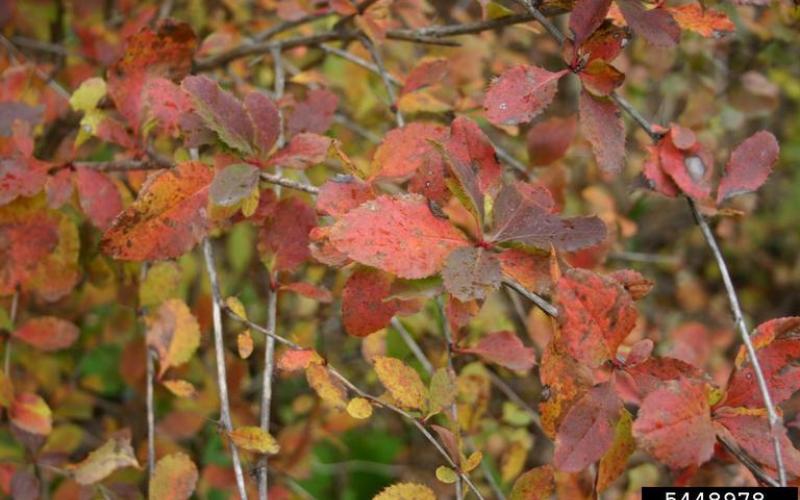 Fall color ranges from yellow to red to purple.
 -
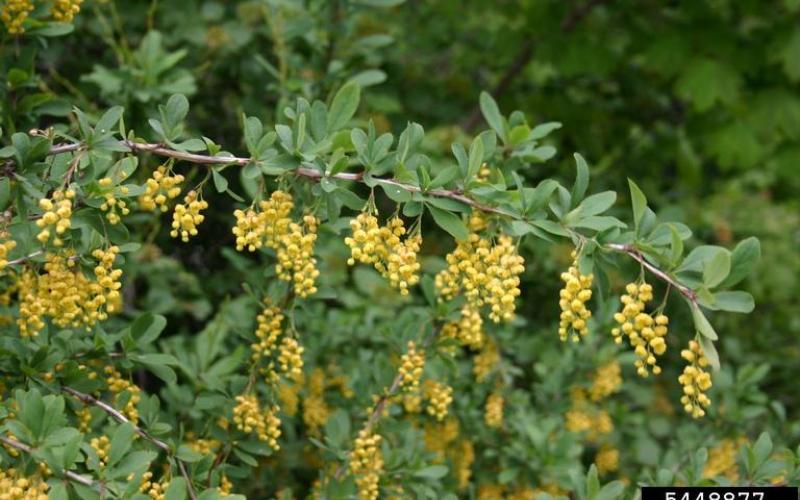 Flowers bloom in May and June and borne in yellow clusters.
 -
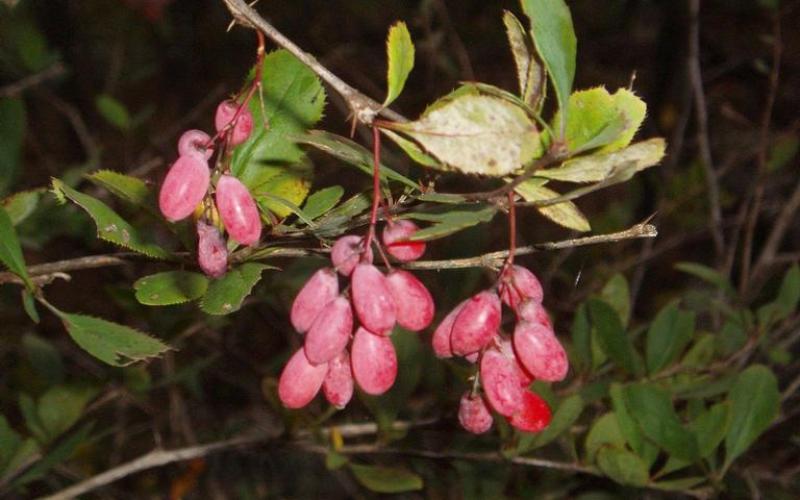 Fruit are small, egg-shaped berries, red to purple in color.
 -
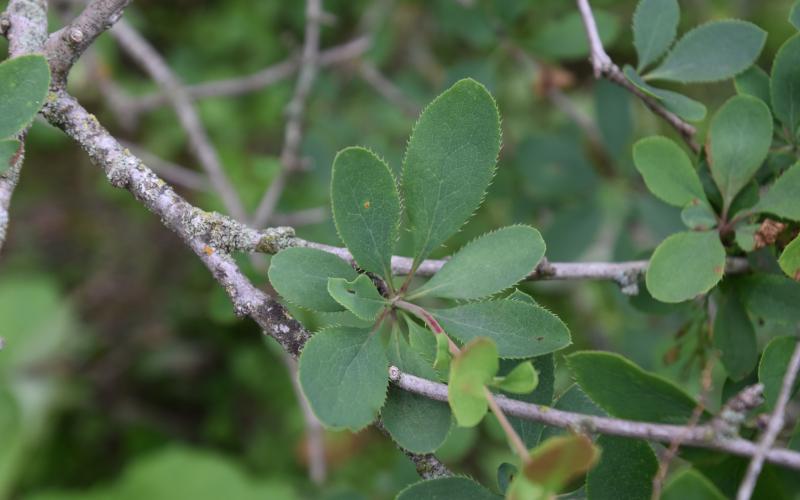 Small, ovate, alternate, toothed leaves are clustered at nodes.
 -
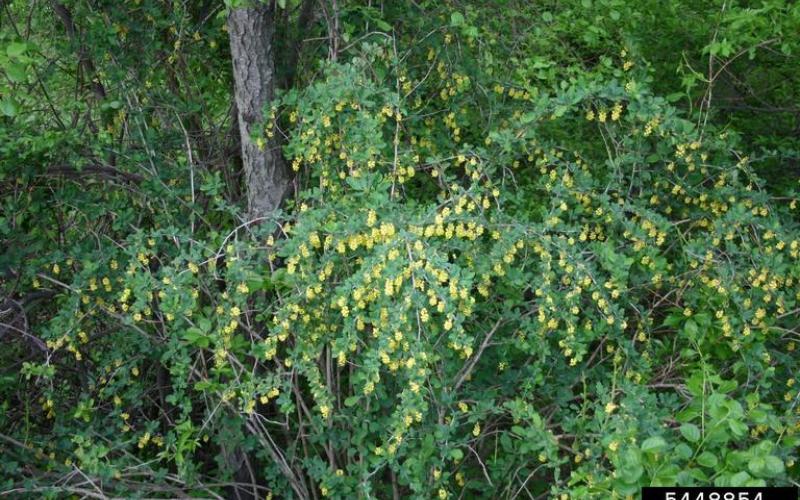 Common barberry is a deciduous shrub, growing up to 10 feet tall.
 -
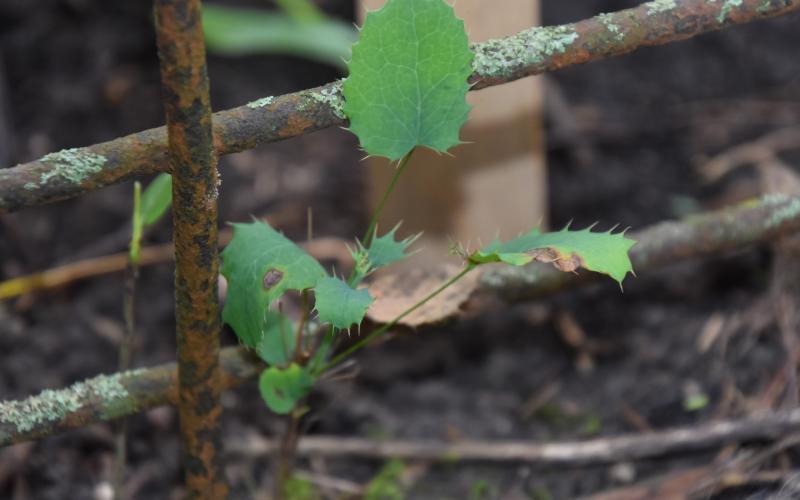 Common barberry is a prolific seed producer and the seeds have a high germination rate.
 -
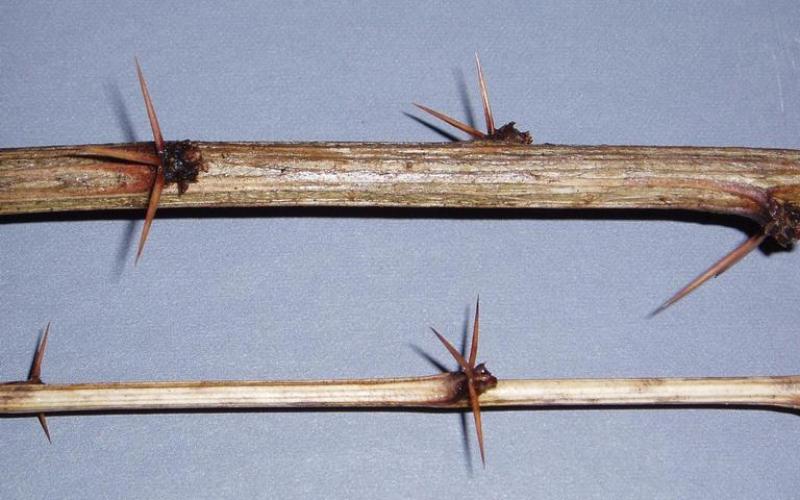 Common barberry has 3-pronged spines along the branches.
 -
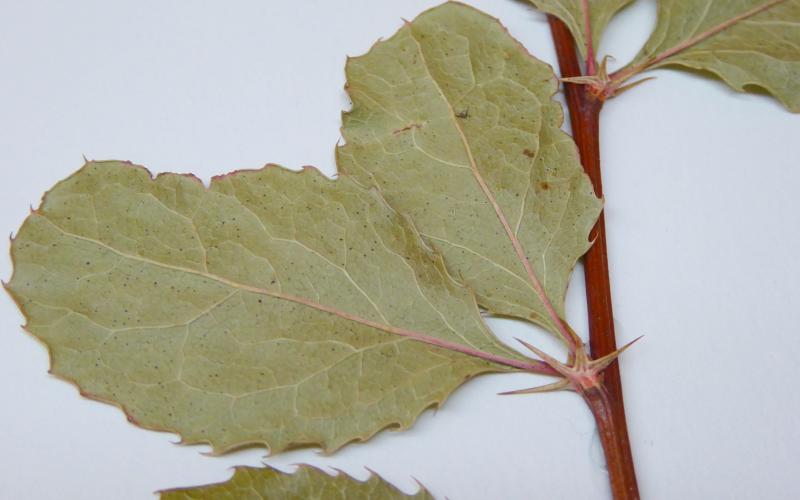 Toothed leaf margins and spines at the leaf nodes are good characteristics of common barberry.
Common Name: Common barberry
Scientific Name: Berberis vulgaris L.
Legal Status
Efforts must be made to prevent seed maturation and dispersal of plants into new areas. Additionally, no transportation, propagation, or sale of these plants is allowed. Failure to comply may result in enforcement action by the county or local municipality.
Background
Common barberry is native to Asia and has become widely naturalized across Europe. It was first introduced to North America in the 1600s by early New England settlers and later escaped from cultivation. It is widely distributed throughout the northern United States. It has been established in Minnesota since the early 1900s and is most common in the southeastern part of the state.
Common barberry is an alternate host for black stem rust, a disease that can cause severe yield losses (50-70%) in small grains. Historical losses were so severe that there was a federal and state eradication effort. From 1918 to 1990, more than 1 million barberry plants were destroyed in Minnesota.
Description
- Common barberry is a deciduous shrub in the barberry family that grows 8 to 10 feet tall and 6 feet wide.
- Leaves are small, ovate, alternate, toothed. They grow in clusters at nodes.
- Bark is gray and has sharp, double- or triple-branched spines along branches.
- Flowers are 1/2 inch long, pale yellow. They grow in drooping clusters that hang from the branches near leaf clusters. The plant blooms in May and June.
- Fruit are small, egg-shaped berries that range from red to purple. Each fruit contains 1-3 small black seeds.
- Common barberry can easily be confused with Japanese barberry (Berberis thunbergii DC.). Common barberry is distinguished by its sharply toothed leaf margins and three-pronged spines lining the branches. It also has taller, more loosely arranged branches than Japanese barberry.
Habitat
Common barberry grows in dense or open woods, pastures, fencerows, roadsides, clearings, and waste spaces. It can grow in full sun to shade and grows in all soil types.
Means of spread and distribution
Common barberry is a prolific seed producer, producing thousands of seeds per bush which are long-lived in the soil and have a high germination rate. Birds are attracted to fleshy berries and disperse seeds to new areas. It also spreads vegetatively from rhizomes (roots) sending up new shoots and can sprout from small rhizome fragments.
Common barberry is most common in the southeastern region of Minnesota.
Impact
Common barberry forms dense stands that outcompete and replace native species. These infestations can reduce wildlife habitat and forage.
It is also an alternate host of black stem rust (Puccinia graminis) and key to sexual reproduction enabling this fungus to produce new races. This stem rust is a fungal disease of concern for small grains like wheat, barley, and oats.
Currently, the threat to wheat production in Minnesota is reduced through the cultivation of rust resistant varieties of wheat. However, there is concern that new rust races could form on common barberry and cause yield losses in small grains.
Prevention and management
- Once established, common barberry is difficult to control. For all management options, infestation sites must be monitored for several years and treated repeatedly until the seedbanks are depleted.
- Plants growing near wheat or other small grain fields should be prioritized for removal.
- Small infestations can be controlled manually by digging and removing the entire root system. All roots must be removed to prevent resprouting. Wear gloves, long sleeves, and long pants to protect yourself from the spines.
- After initial removal, regular mowing or spraying of any seedlings or resprouts may help maintain control.
- Large infestations can be controlled with either foliar or cut-stem herbicide applications. Treatments will need to be repeated for several years to eradicate the population. If using herbicide treatments, check with your local University of Minnesota Extension agent, co-op, or certified landscape care expert for assistance and recommendations. There are several businesses throughout the state with certified herbicide applicators that can be hired to perform chemical applications.

