
-
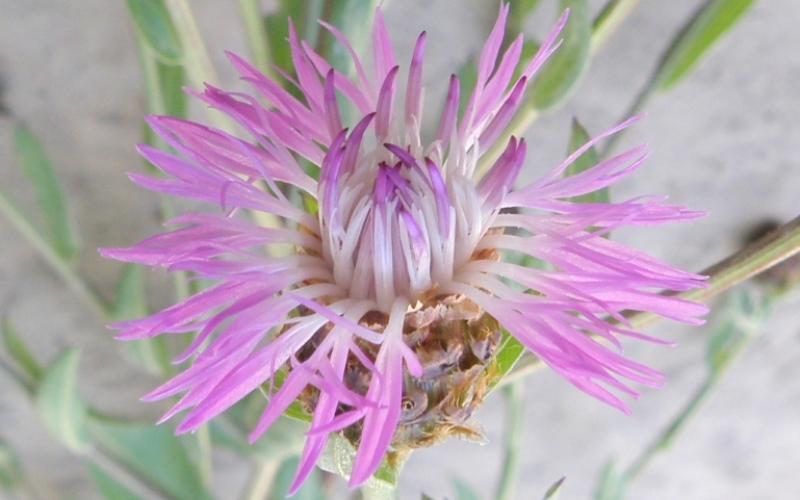 Flowers can be pink with white centers.
 -
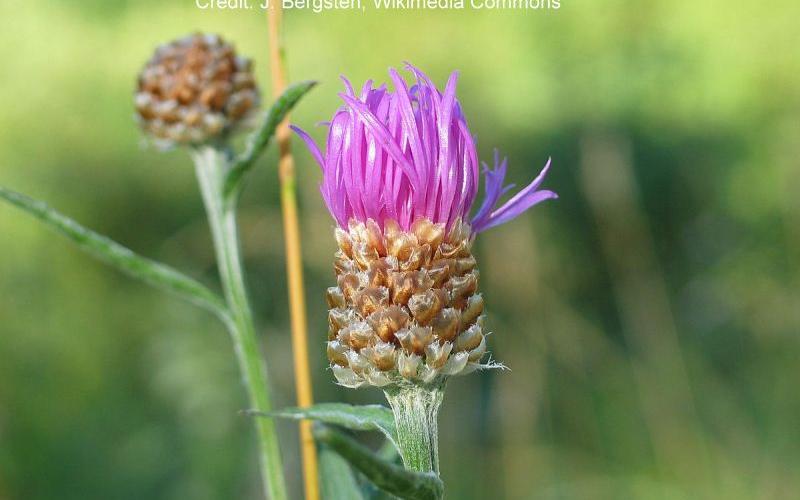 The bracts below the flowers are rounded and wide, and are brown.
 -
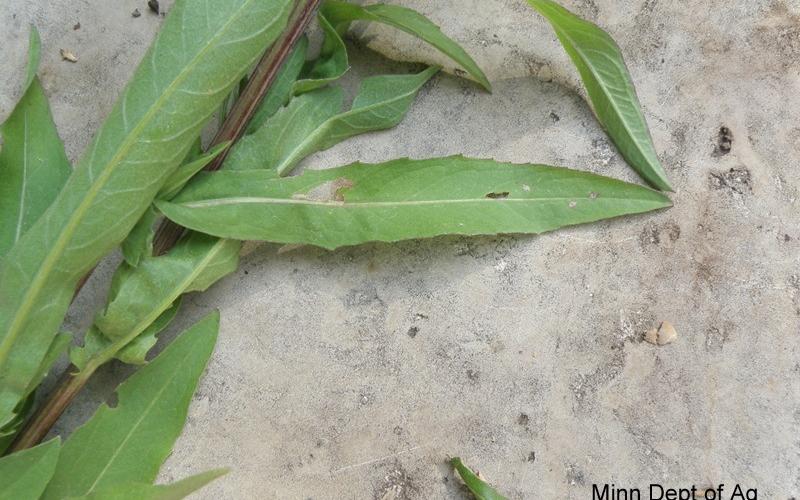 Leaves are lance shaped and hairy.
 -
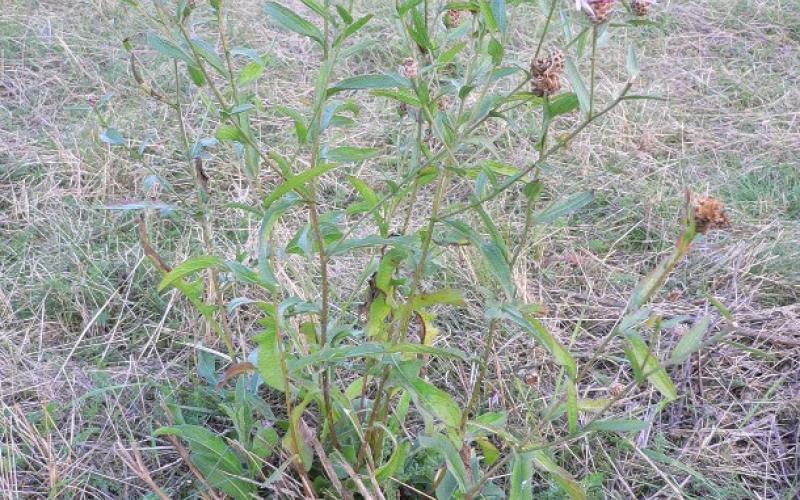 Perennial plant with multiple, upright, reddish stems.
 -
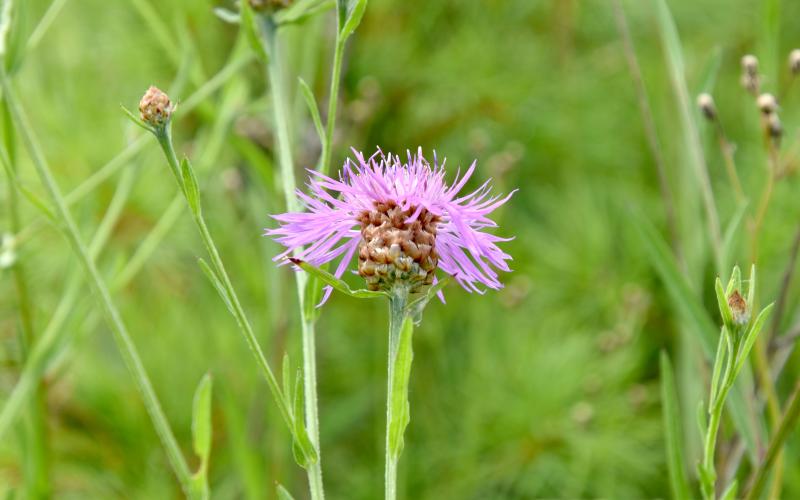 Flowers are pink or purple, sometimes with white centers.
 -
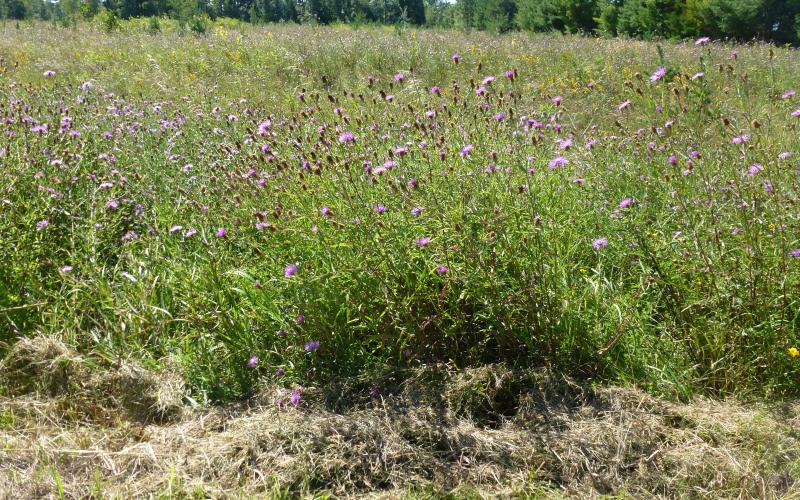 Individual brown knapweed plants can have many branching stems. Plants can spread rapidly forming dense infestations.
Common Name: Brown Knapweed
Scientific Name: Centaurea jacea L.
Alternate Names: Brown-rayed knapweed, brown-ray knapweed and brownray knapweed
Related Species: Other knapweeds and hybrids including spotted knapweed Centaurea stoebe L. ssp. micranthos (Gugler)
Legal Status
All above and below ground parts of the plant must be destroyed. Additionally, no transportation, propagation, or sale of this plant is allowed. Failure to comply may result in an enforcement action by the county or local municipality.
Background
Brown knapweed is native to Europe. It was introduced to North America as a forage plant, but it has low palatability and nutritional value. It escaped cultivation and has become invasive but is not common in Minnesota.
Description
- Brown knapweed is a perennial plant with multiple upright, reddish stems that grow 1 to 4 feet tall.
- Small, individual flowers are clustered to form composite flower heads. Flowers are mostly pink to purple and sometimes have white centers. They are borne at the ends of branches and are about 1 inch in diameter. Flowering occurs from mid-summer until fall. After flowering, plants produce white to light brown seeds with short plumes.
- The bracts below the flowers are rounded and wide at the tip, often with brown tips.
- Leaves are alternate, lance-shaped, and pubescent (hairy). They may have wavy margins (leaf edges) or be lobed. Basal leaves grow up to 4 inches long.
- Seedlings are tap-rooted, and mature plants develop a cluster of roots below the crown.
Spotted knapweed is a similar species that is common in Minnesota. The two knapweed species are easily distinguished by leaf shape and color. Spotted knapweed leaves are gray-green and are more deeply lobed.
Habitat
Brown knapweed can be found growing in woodland clearings, yards, ditches, disturbed areas, pastures, and other grasslands. It thrives in sunny locations but is also somewhat shade tolerant. It thrives in cool, moist locations.
Means of spread and distribution
It spreads by seed that can be moved by wind, water, wildlife, equipment and humans. Brown knapweed has been documented at a small number of sites in northern Minnesota.
Impact
Brown knapweed outcompetes desirable species and forms large monocultures. Forage quality, species diversity and wildlife habitat are reduced. A similar weed species, spotted knapweed, is abundant in Minnesota. The two species can hybridize if they co-exist, potentially resulting in vigorous hybrids. This risk adds to the rational for brown knapweed eradication in Minnesota.
Prevention and management
- To prevent the spread of this brown knapweed, clean equipment, vehicles, and footwear before transportation from brown knapweed-infested areas.
- For all management options, infestation sites will need to be monitored and treated repeatedly until the seedbanks are depleted.
- A combination of hand-pulling and digging is an option for small infestations.
- Herbicides are a very effective management tool for brown knapweed. For specific herbicide recommendations, contact your University of Minnesota Regional Extension Educator.
- Mowing does not control brown knapweed, and the mower may spread seeds.
- Biological control was developed for some other knapweed species but is not an effective control option for brown knapweed.

