
-
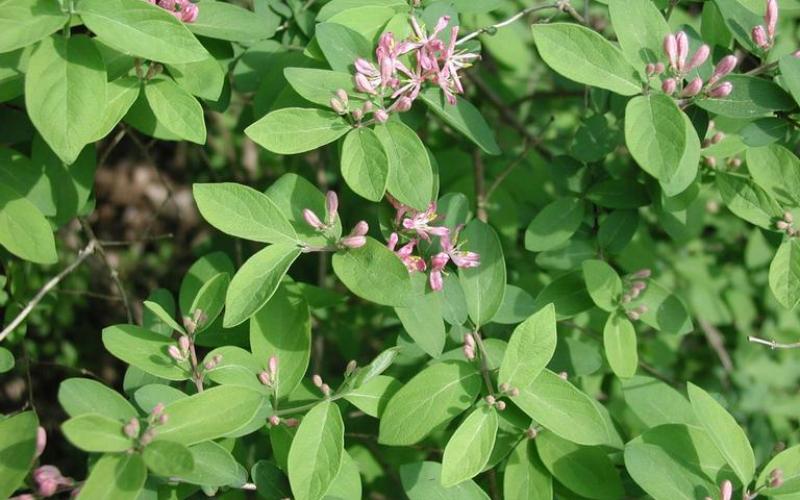 Flowers are fragrant, pink, fading to yellow, tubular, and arranged in pairs. Bloom time is mid- to late spring.
 -
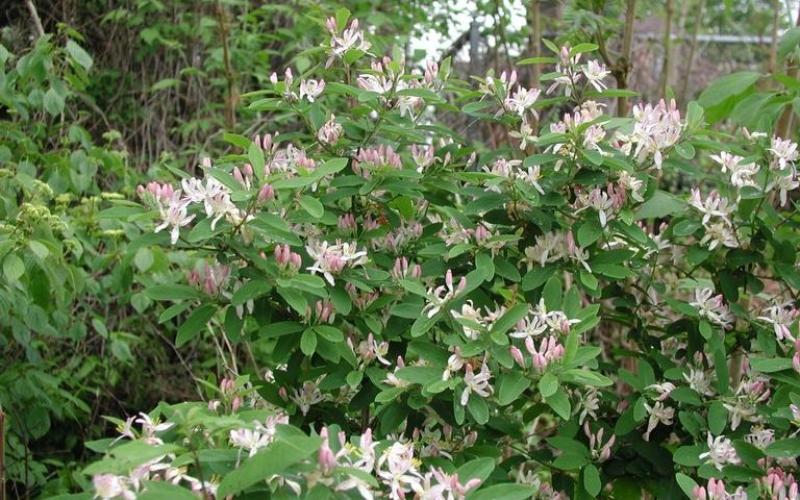 Bell’s honeysuckle is a multi-stemmed deciduous shrub, reaching a height of 20 feet.
 -
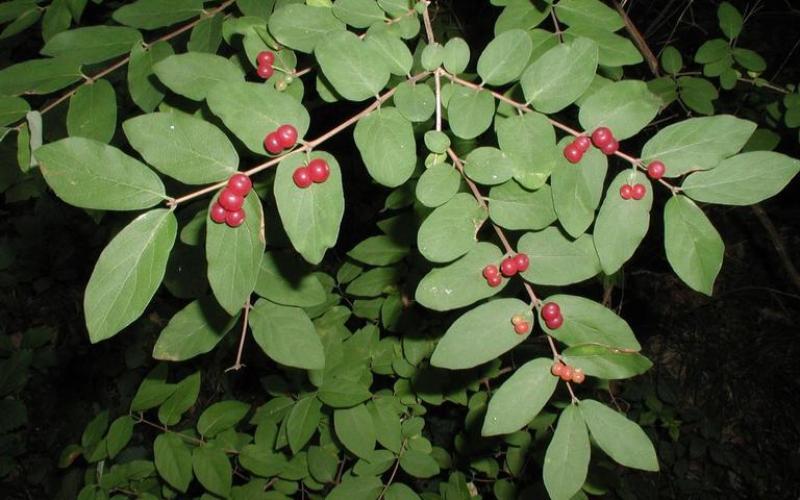 Fruits are red or orange spherical berries, occurring in pairs at leaf axils, each containing many seeds.
 -
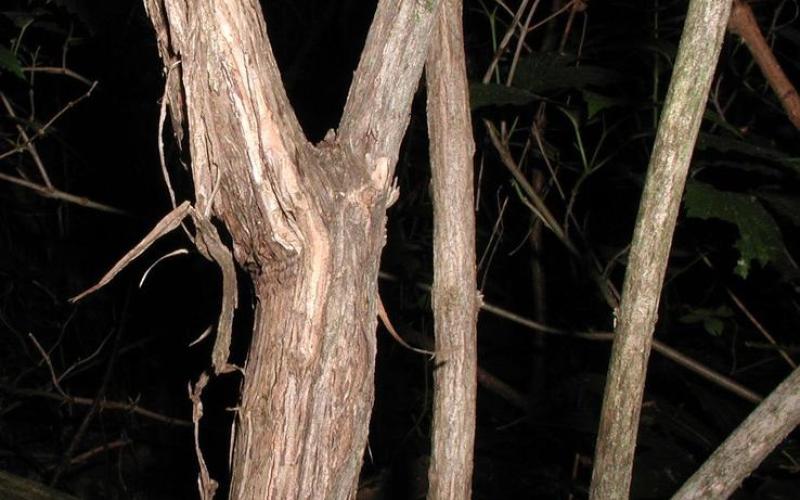 Bark is brown and shreddy.
 -
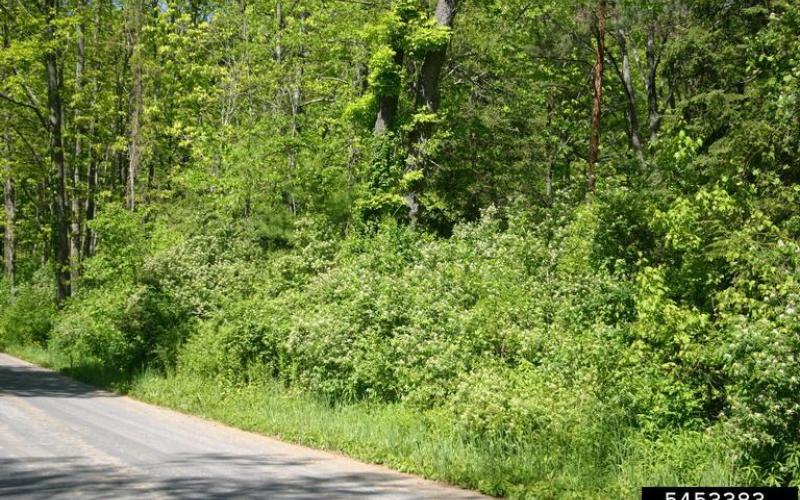 Bell’s honeysuckle can invade a broad range of habitats, including open woods, fens, bogs, lakeshores, roadsides, pastures, old fields, and wood’s edges.
 -
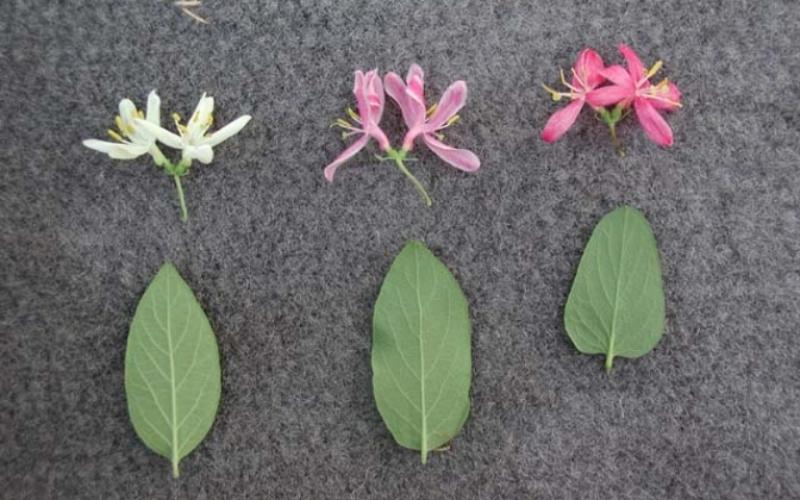 Leaves can range in shape from oval to triangular and flowers can vary in color from white to dark pink.
Common Name: Bell’s Honeysuckle
Scientific Name: Lonicera x bella Zabel (Hybrid of Lonicera morrowii and Lonicera tatarica)
Legal Status
Propagation and sale of this plant are prohibited in Minnesota. Transportation is only allowed when in compliance with Minnesota Statute 18.82. Although Restricted Noxious Weeds are not required to be controlled or eradicated by law, landowners are strongly encouraged to manage these invasive plants on their properties in order to reduce spread into new areas.
Background
Bell’s honeysuckle is a hybrid of two non-native species—Morrow’s honeysuckle (L. morrowii), which is native to Japan, and Tartarian honeysuckle (L. tatarica), which is native to Eurasia.
It has become naturalized in many northeast and midwestern United States. It spread from deliberate horticultural, wildlife habitat, and erosion control plantings, and is now widely distributed throughout Minnesota.
Description
- Bell’s honeysuckle is a multi-stemmed deciduous shrub that can reach a height of up to 20 feet. It can be easily confused with similar species like Morrow’s, Tatarian or Amur honeysuckles, which are distinguished by slight differences in flower color and leaf pubescence. See the Minnesota Department of Transportation guide for comparisons of various honeysuckle.
- Leaves are opposite and oval with smooth edges. They may be hairless or downy and range from green to green blue. Leaf-out occurs slightly earlier in spring than many native species, and leaves drop slightly later in the fall.
- Flowers are fragrant, pink, fading to yellow, tubular, and arranged in pairs. They bloom from mid- to late spring.
- Fruits are red or orange spherical berries that occur in pairs at leaf axils. Each berry contains many seeds.
- Roots are fibrous, shallow, and readily produce suckers.
- Bark is shaggy and peeling. Stems are often hollow between the nodes. Young stems are slightly hairy and light brown.
Habitat
Bell’s honeysuckle can invade a broad range of habitats, including open woods, fens, bogs, lakeshores, roadsides, pastures, old fields, and woodland edges. It thrives in sunny sites and is relatively shade intolerant.
Means of spread and distribution
Bell’s honeysuckle reproduces asexually by root suckering and layering. The main method of spreading to new sites is through seed dispersal by birds. Bell’s honeysuckle produces abundant seeds that are spread by birds.
Bell’s honeysuckle is widespread throughout Minnesota.
Impact
High densities of honeysuckle can suppress native plant and timber regeneration and form monocultures. Ecosystem richness and the density of tree seedlings are substantially reduced in areas with honeysuckle infestations.
This species can alter a habitat’s microclimate, by creating dense shade, depleting soil moisture and nutrients, and possibly releasing allelopathic chemicals that inhibit the growth of other plants. It can be especially harmful to spring ephemerals due to early leafing.
Prevention and management
- Once established, Bell’s honeysuckle is difficult to control. For all management options, infestation sites must be monitored and treated repeatedly for 3- 5 years until seedbanks and suckers are depleted.
- Do not plant invasive honeysuckle species as ornamentals and remove existing plants on your property. Native species can be planted as alternatives. A list of alternatives is available in the MIPN Landscape Alternatives brochure.
- Young plants can be pulled by hand. Mature plants can be removed using a weed wrench tool or by repeated cutting. Keep in mind that physical removal can disturb soils and may result in reinvasion or resprouting of honeysuckles and other exotics.
- Prescribed burning can be an effective tool when used in combination with other techniques. Spring burning will kill seedlings and the tops of mature plants. Make sure to contact the Minnesota Department of Natural Resources to learn more about controlled burning practices and regulations.
- Foliar, stem injection, and cut-stem herbicide applications that translocate active ingredients into the root system can be very effective. Treatments must be repeated for several years to eradicate a population. If using herbicide treatments, check with your local University of Minnesota Extension agent, co-op, or certified landscape care expert for assistance and recommendations.
- Several businesses throughout the state have certified herbicide applicators who can be hired to perform chemical applications.

