
-
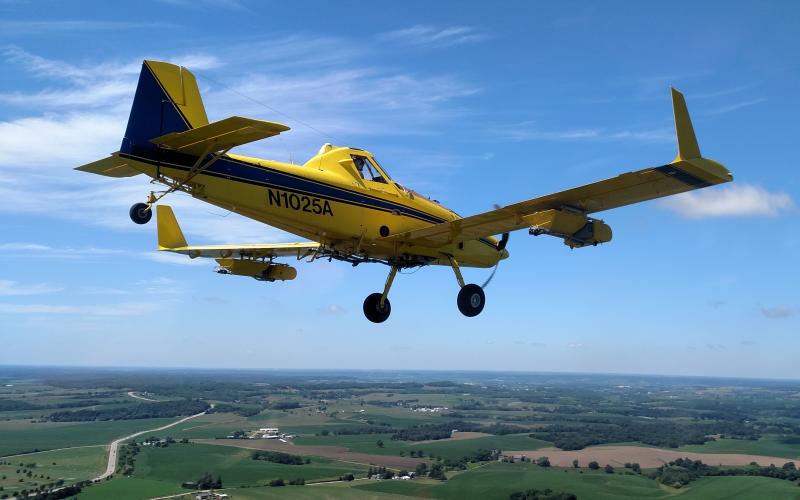
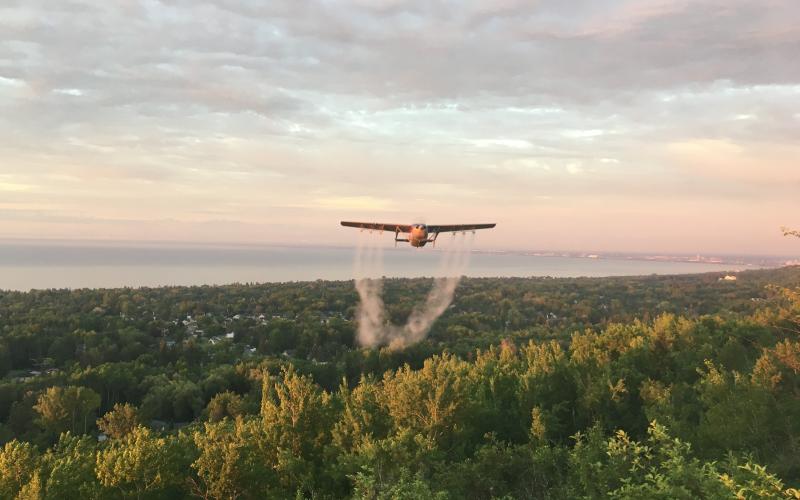
 Management activities use aircraft that make repeated passes over each management block.
 -
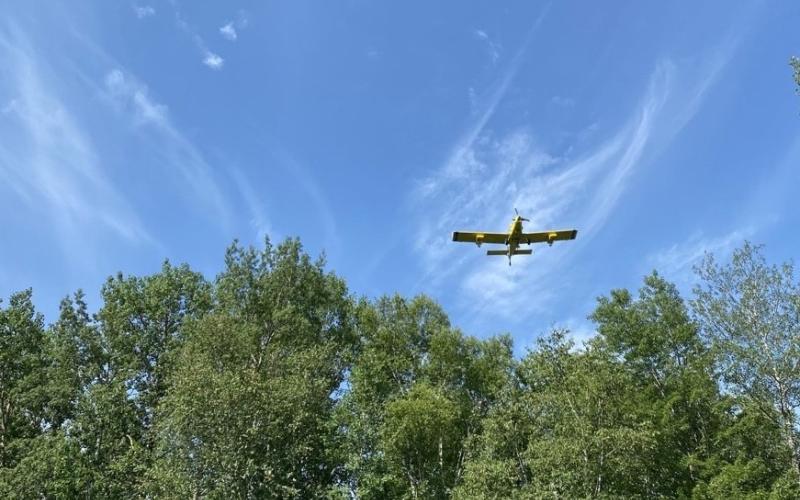 Aircraft will fly low (about 100–200 feet above the treetops) and may be loud.
 -
-

-
Return to spongy moth main menu
2026 Spongy Moth Management in Minnesota - Completed
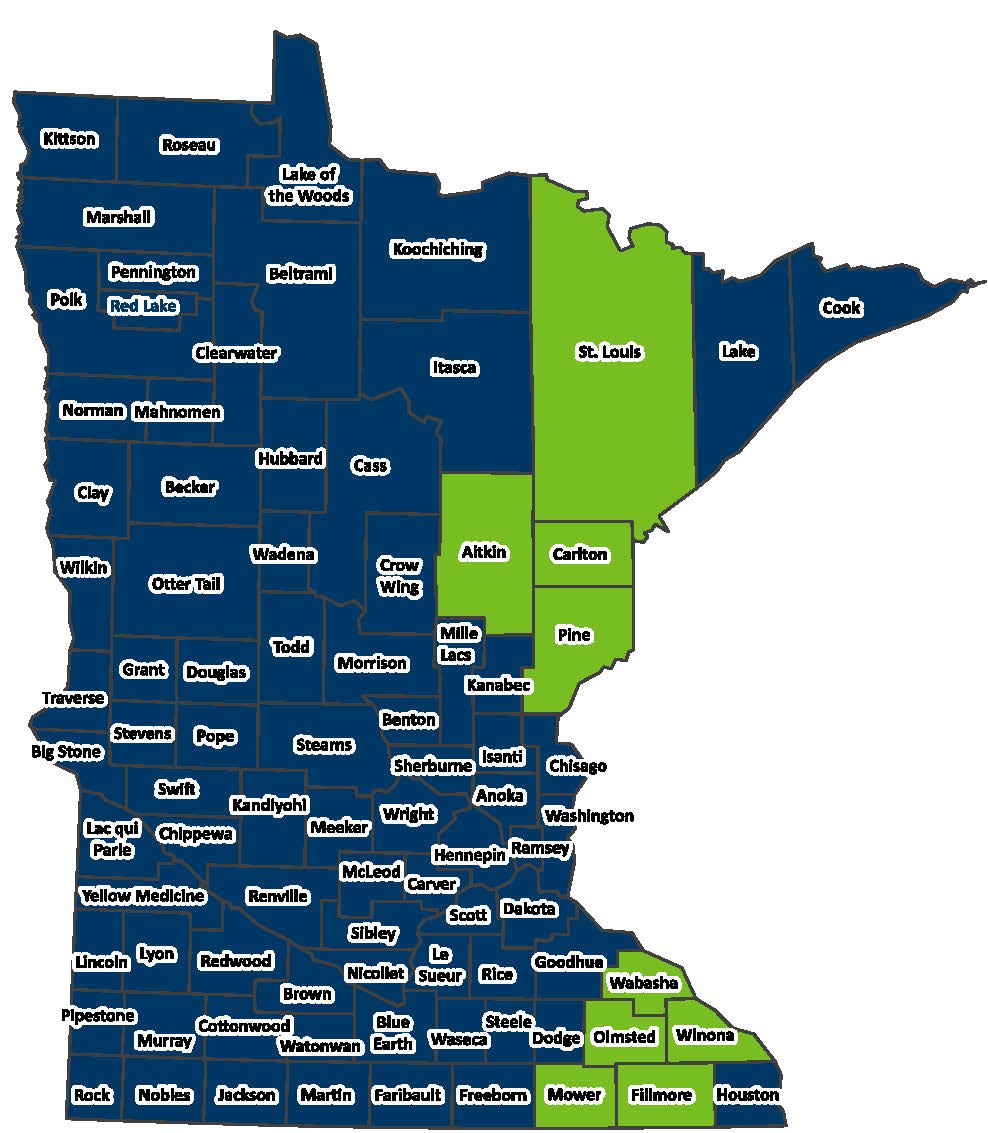
In June and July, the Minnesota Department of Agriculture (MDA), in partnership with the United States Department of Agriculture Forest Service, completed aerial treatments to manage spongy moth (formerly gypsy moth) in nine counties. In northeast Minnesota management activities occurred in Aitkin, Carlton, Pine, and St. Louis counties. In southeast Minnesota management activities occurred in Fillmore, Mower, Olmsted, Wabasha, and Winona counties.
Spongy moth management was conducted by the Minnesota Department of Agriculture (MDA), in partnership with the U.S. Department of Agriculture (USDA) Forest Service Slow the Spread (STS) program and local partners.
Management Activity Areas
Click the map to view management areas.
Spongy Moth Management
For decades, the Minnesota Department of Agriculture (MDA), ten states, and the U.S. Department of Agriculture (USDA) Forest Service have partnered through the national Slow the Spread (STS) program to reduce spongy moth populations—an invasive and destructive forest pest—by more than 60%.
The STS program guides management strategies based on trap catches, alternate life stage surveys, and the size of management areas.
Product Questions
The MDA uses the product SPLAT GM-O for mating disruption. SPLAT GM-O is used in areas where low populations of spongy moth have been detected.
Mating disruption uses pheromone-based products to confuse adult moths and prevent them from reproducing. Mating disruption floods the area with the scent of the female moth and confuses male spongy moths so they cannot find females. They die without reproducing. The product does not actually kill moths.
Pheromones are non-toxic compounds that insects use to communicate. The female spongy moth does not fly and must attract the male moths with pheromones.
SPLAT GM-O is certified by EPA as safe and allowable for use in organic food production. It is made of food grade materials and has the consistency of hand cream. SPLAT GM-O uses pheromone to disrupt spongy moth mating habits without impacting other insects, mammals, or the surrounding environment. SPLAT stands for Specialized Pheromone and Lure Application Technology. GM-O stands for Gypsy Moth Organic.
Human Health Questions
SPLAT GM-O is completely non-toxic and harmless to humans and animals. All the ingredients in SPLAT GM-O are listed by the EPA's as safe and allowable for use in organic food production.
Scientific research shows that SPLAT GM-O is not harmful to humans. Individuals with a weakened immune systems or serious food allergies may choose to avoid any potential for exposure by staying indoors during and at least 30 minutes after the treatment, or leaving the area during the application.
Environmental Questions
SPLAT GM-O is not toxic to humans, other mammals, fish, birds, or honeybees. SPLAT GM-O is biodegradable and uses pheromones to disrupt the mating activities of the spongy moth. It is a non-lethal means of control.
Btk only works under the conditions present in the stomach of insects in the caterpillar stage of development. This condition is not present in the stomachs of humans, mammals, fish, birds, or honeybees.
SPLAT GM-O is formulated to specifically target the spongy moth. It will not impact the mating activities of other insects.
For Btk have any effects, caterpillars must be actively feeding within approximately two weeks after treatment, they must eat the Foray, and they must be susceptible to the bacteria. The MDA works with the Minnesota Department of Natural Resources and the U.S. Fish and Wildlife Service to identify and evaluate impacts to any threatened or endangered species, and ensure that no sites of sensitive, threatened, or endangered species of moths and butterflies overlap with Foray treatments.
SPLAT GM-O will not harm the paint on your vehicle or outdoor structures. It won't cause any damage and can be easily washed off. To clean it from surfaces, use a mild detergent and water to wash the product off as you would road grime. Clothing can be cleaned with hot water and laundry detergent.
No, Btk/Foray will not harm vehicle paint or outdoor structures and can be easily washed off. The spray may be more noticeable on dark-colored vehicles. If it’s left in the sun for several days, the residue may dry and become harder to remove. In that case, rehydrate the area by placing a towel soaked in soapy water over it for a few minutes before wiping clean. You may need to use a bit more effort if the spray has been sitting for a while.
Btk FAQs
Btk is a naturally, occurring bacterium that is found in the soil. The product is applied to the treetops where spongy moth caterpillars are feeding. When ingested, the bacterium is toxic to certain susceptible caterpillars like the spongy moth. Caterpillars stop feeding and die within a couple days.
Foray is the commercial product containing Btk. The inactive ingredients used in Foray are certified organic food-grade ingredients and contain no petroleum solvents. The Foray Btk is not genetically engineered, and the product is gluten free.
The product is applied to the treetops by low flying aircrafts where spongy moth caterpillars are feeding, often this occurs in May and June.
When the caterpillars feed on the leaves, they ingest the products. The bacterium in Foray is toxic to the caterpillars, they stop feeding, and die within a couple days.
Applications occur twice, about a week apart. Application normally takes place early in the day when low winds and high humidity allow the product droplets to land on tree tops where they will be the most effective. A management site will typically be finished before children are walking to school or people are heading to work.
Btk has a proven safety record with people, pets, birds, fish, livestock, and other insects such as bees; and has been registered and re-registered many times by the Environmental Protection Agency (EPA) for use in the U.S., to use on more than 200 food and fiber crops.
People are exposed to Btk through contact with soil in the natural environment or through their diet, at very low levels. If you eat fresh fruits or vegetables, you probably have already ingested this bacterium. It is commonly used on commercial and organic food crops.
Some people have reported mild skin reactions or mild eye, ear, and nose irritations after Btk treatments. Others have reported mild hay fever reactions. Health officials have studied these reports extensively and have not been able to determine if the reactions were caused by Btk or by pollens, molds, or dust generated during the treatments, or were unrelated to Btk treatments.
Public health officials state Btk is not a public health risk.
Although we don't have evidence that Btk will affect any given group of people, individuals with a weakened immune systems or serious food allergies may choose to avoid any potential exposure by staying indoors during and at least 30 minutes after the treatment or leaving the area during the application.
Given the long history of use and the knowledge that regulatory and public health officials have about Btk and Foray, there is no reason to suspect that either Foray or Btk is carcinogenic.
You can read more about Bt and human health from the National Pesticide Information Center.

