
The Minnesota Department of Agriculture (MDA) has resources to assist you if pesticide drift impacts your crop. Report suspected drift incidents to the Pesticide Fertilizer and Management Division (PFMD) as soon as possible to initiate an investigation. Waiting too long after the drift occurs could result in pesticide or herbicide product dissipation, which means it may not be detectable during sampling. Drift complaints can be reported online or by calling 651-201-6333.
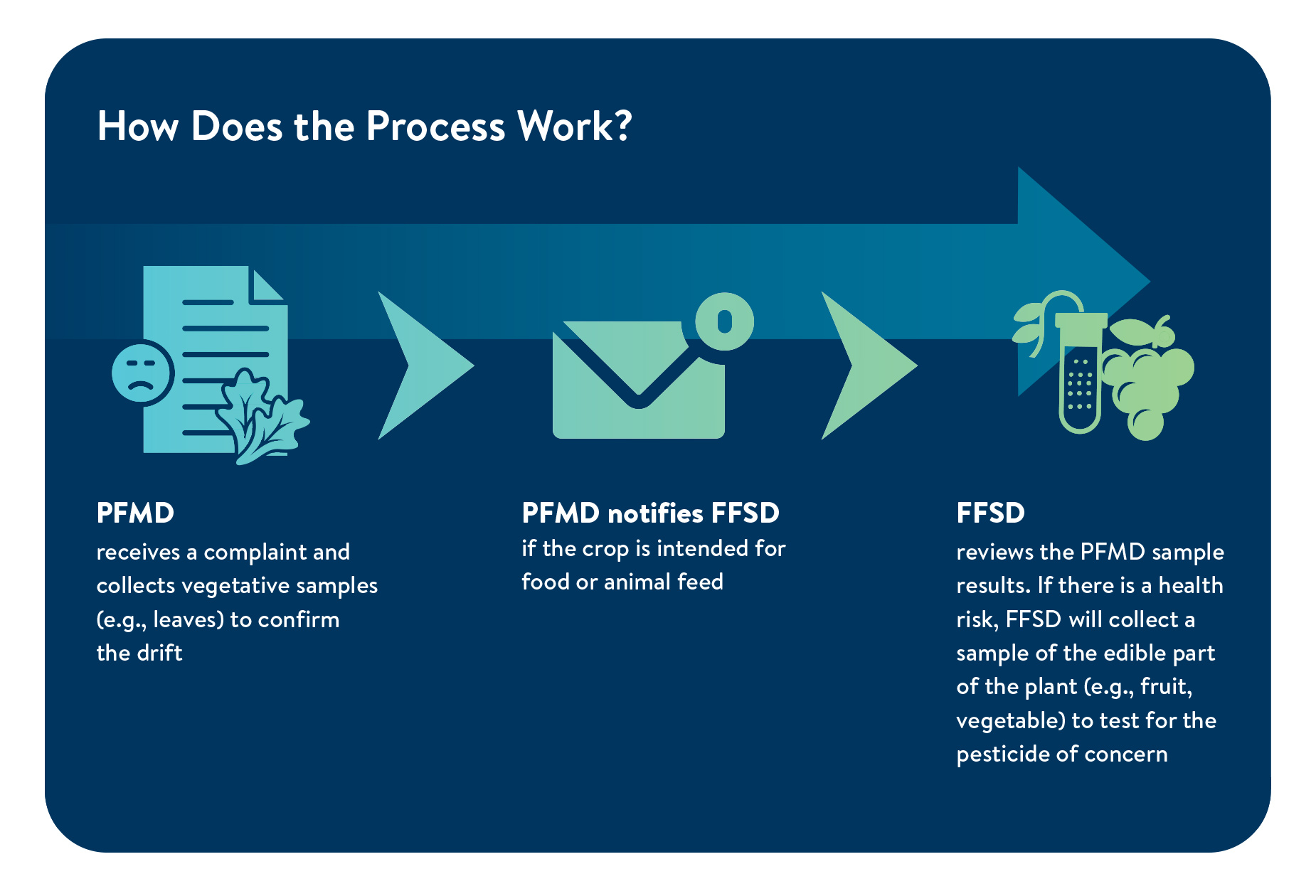
PFMD will investigate the drift complaint to determine the type of drift and responsible party. If the affected crop is used for human or animal food/feed, the MDA’s Food and Feed Safety Division (FFSD) will then perform a safety review of the edible portion of the crop. While PFMD focuses on the drift incident and takes enforcement actions based on its investigation, FFSD will determine if your crop presents a health risk or if it can enter commerce as normal.
How long does the review take?
Several variables can affect the length of a review and investigation. The MDA’s goal is to provide a timely food or feed safety determination that has little or no impact on your operation. We prioritize each case based on several factors, which include:
- Estimated harvest date
- Type of crop
- Intended sale/distribution date or estimated length of time in storage prior to sale/distribution
These factors assist in establishing a timeline and in prioritizing cases.
What FFSD actions may result from the initial PFMD samples?
The PFMD collects the first set of samples to determine if drift occurred and the pesticides of interest. These initial samples are taken from one part of the field, generally the most visually affected plants.
- No detection, crop is not adulterated: PFMD drift samples are reported as “no detection,” which means the lab was unable to find any trace of the pesticides identified as a potential risk. No additional FFSD sampling is required.
- Detection, but within tolerance: The pesticide of concern was identified but is within a tolerance level allowed for your crop. No additional FFSD sampling is required.
- Detection and further analysis needed: FFSD sends a letter advising that we need to conduct additional sampling of your crop. This happens when the detection levels for a pesticide are higher than the tolerance for your crop. FFSD will sample edible portions of your crop to determine human or animal health risk.
How is FFSD sampling different?
When the FFSD collects samples, we are looking at the edible crop in your entire field and determining if it has been adulterated by the drift.
How long does FFSD sampling take?
If PFMD determines there is a potential food safety concern, FFSD will conduct sampling of the food or feed crop. FFSD sampling typically takes 1-2 weeks. After receiving sample results, FFSD can advise if the field has been adulterated and what next steps need to be taken.
What happens if my crop is adulterated?
In the event your crop is determined to be adulterated, it can no longer be used for human or animal consumption. You may utilize the crop for non-food or feed purposes, or you may elect to destroy the crop.
Can I skip the FFSD food and feed safety review?
At any point in the review process, you may choose to destroy your crop or use it for non-food or feed purposes. The food and feed safety review is required if you intend on harvesting and selling your crop as a food or feed commodity. In some situations, a farm may decide to destroy their crop and replant. If the crop has been destroyed and is unusable, PFMD will still perform their investigation into the drift and take necessary actions depending on the result of their investigation. However, FFSD will not conduct a food and feed safety review if the crop will not be entering commerce.
Questions?
If you have questions about the food and feed safety review, please contact FFSD at 651-539-3648 or MDA.FFSDResponse@state.mn.us.
If you have questions about pesticide drift investigations, please contact PFMD at 651-201-6333.

