
New World screwworm (NWS) remains a serious animal health threat and has been detected in Texas and New Mexico.
NWS is a type of fly that lays eggs in open wounds or around the eyes, ears, nose, and mouth of live, warm-blooded animals. When the eggs hatch, the larvae (maggots) feed on healthy, living tissue, causing painful wounds that can grow larger over time. NWS can affect livestock, pets, wildlife, and, in rare cases, people. If not treated, these infestations can cause severe damage and may even lead to death. Only NWS flies spread this animal health threat.
NWS is not a food safety or foodborne illness issue, it does not spread through meat or food, and infested animals (inspected at slaughter) won’t make it into the human food supply.
USDA Response
To help eradicate NWS, the United States Department of Agriculture (USDA), is releasing sterile male flies in the area of the positive site, in addition to the four million sterile flies already being released each week. They have implemented an infestation zone of 20 km around the detection site and are implementing quarantines, movement controls, and surveillance.
Minnesota Board of Animal Health Response
The Minnesota Board of Animal Health has announced new restrictions on the importation of dogs and cats from states with active NWS infestations, including a ban on importing any animals from an actively infested NWS site. These domestic restrictions are in addition to existing international restrictions on companion animal imports from NWS endemic areas published in April.
Livestock Producer Information
Livestock producers should be aware that newborn animals (umbilical cords), newly freshened animals, and animals that have been wounded, dehorned, branded, ear-notched, sheared, tail docked or castrated are susceptible to NWS.
If you suspect New World screwworm in an animal, isolate the animal immediately, contact your veterinarian, and report the case to your State Animal Health Official or USDA APHIS.
Livestock infested with NWS will be treated and quarantined until all wounds heal and there is no evidence of re-infestation after 21 days. In rare cases, euthanasia may be necessary for individual animals for humane reasons or in cases when treatment is not possible.
To help prepare for a possible NWS outbreak in the United States, the FDA has issued Emergency Use Authorizations (EUAs) for several products used to prevent and treat NWS infestations, including over-the-counter ointments, wound spray, injectable drugs, and prescription-only topical powder.
FDA-Authorized Drug Treatments for New World Screwworm
| Drug Name | Animal | Milk Withdrawal | Meat Withdrawal |
| Bimectin® (Ivermectin) injection, Ivomec® (Ivermectin) injection | Cattle* | Do not use in lactating cattle | 35 days* *Not for use in veal calves |
| CLik Extra (dicyclanil) | Dairy cattle, dairy goats | Do not use | |
| CLik Extra (dicyclanil) | Meat animals - cattle, goats, sheep, swine, cervids, bison | 86 days | |
| Dectomax®/Dectomax®-CA1 (doramectin injection) | Lactating & non-lactating dairy >20 months
| 19.5 Days | 35 Days |
| Dectomax®/Dectomax®-CA1 (doramectin injection) | Beef cattle | 35 Days | |
| Dectomax®/Dectomax®-CA1 (doramectin injection) | Veal calves | Not Approved | |
| Dectomax®/Dectomax®-CA1 (doramectin injection) | Swine | 24 Days | |
| Dectomax®/Dectomax®-CA1 (doramectin injection) | Non-lactating sheep | 35 Days | |
| Dectomax®/Dectomax®-CA1 (doramectin injection) | Deer | 35 Days | |
| Exzolt® Cattle-CA1 (fluralaner topical solution) | Dairy cattle replacement heifers <20 months | Do not use in lactating cattle | 98 days* *Not for use in bulls intended for breeding 1 year of age and older *Not for use in dairy calves or veal calves |
| Exzolt® Cattle-CA1 (fluralaner topical solution) | Beef cattle >2 months* | 98 days* *Not for use in bulls intended for breeding 1 year of age and older *not for use in veal calves | |
F10® Antiseptic Wound Spray with Insecticide and F10® Antiseptic Barrier Ointment with Insecticide
| Dairy cattle, dairy goats, dairy sheep | 10 Days | 30 Days |
F10® Antiseptic Wound Spray with Insecticide and F10® Antiseptic Barrier Ointment with Insecticide
| Cattle, non-lactating sheep and goats | 30 Days | |
F10® Antiseptic Wound Spray with Insecticide and F10® Antiseptic Barrier Ointment with Insecticide
| Veal calves | Not Approved | |
| Negasunt® Powder * | Dairy animals | Do Not Use | |
| Negasunt® Powder * | Meat animals | 28 Days | |
| Negasunt® Powder * *Prescription only in NWS infested and adjacent surveillance zones | Veal calves | Not Approved |
Visit the USDA New World Screwworm site for more information.
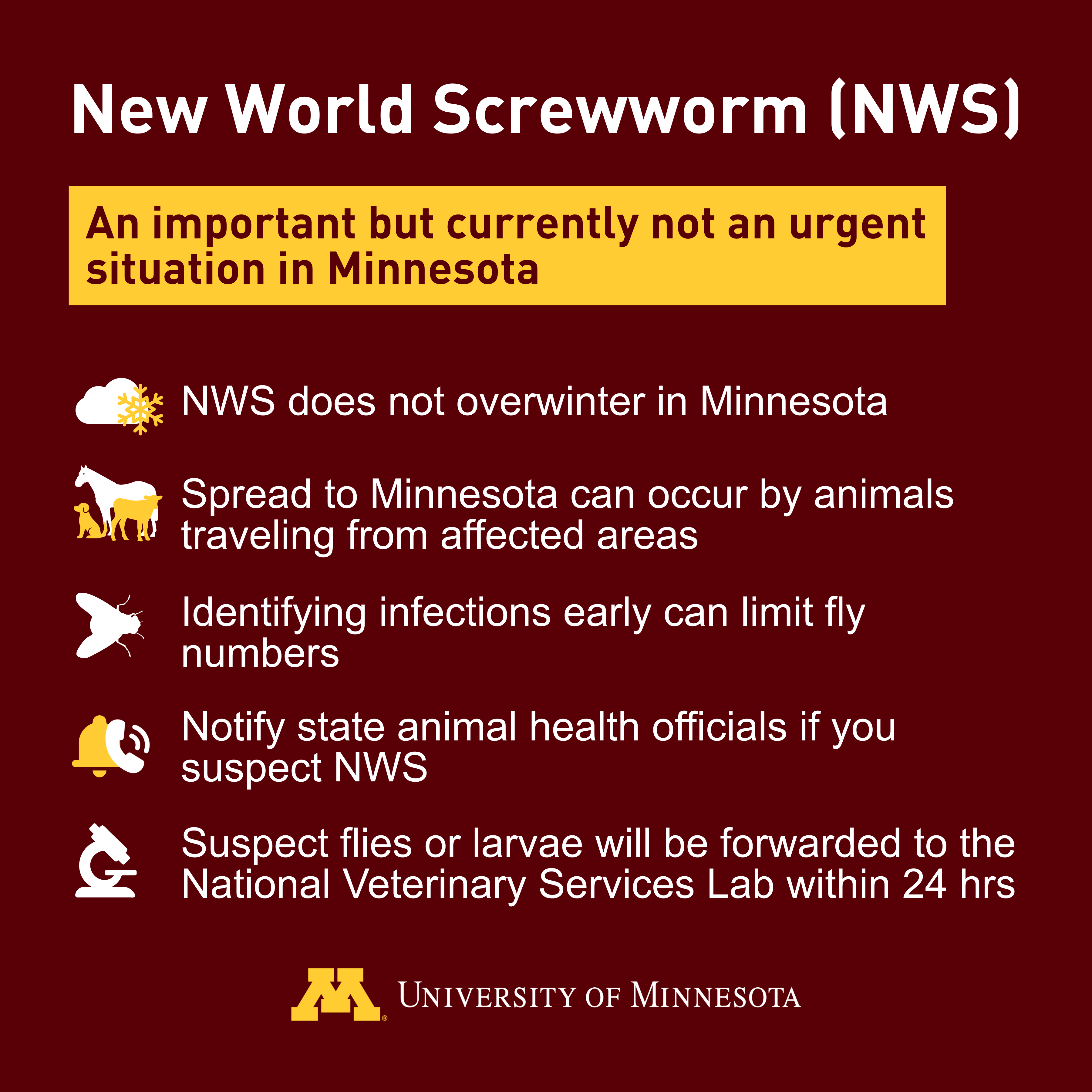
The University of Minnesota Extension Office has also issued guidance about the impact of NWS in northern climates.
Pet Information
Traveling pets are at risk of NWS, not just horses and livestock. Animals can still travel during a NWS outbreak because this infestation is preventable and treatable. Know the signs, and check your animals.
Before and after travel, check your animals and pets daily.
Look: Inspect for wounds around the eyes, ears, or lips of your pet.
Feel: Run your hands over their entire body and belly, parting the fur.
Smell: Note if you smell anything out of the ordinary.
Coordinate early with your veterinarian in advance of your travel dates for a Certificate of Veterinary Inspection before crossing state lines.

