
View the map of 6 inch soil temps. Find the current reading and the trend for the week.
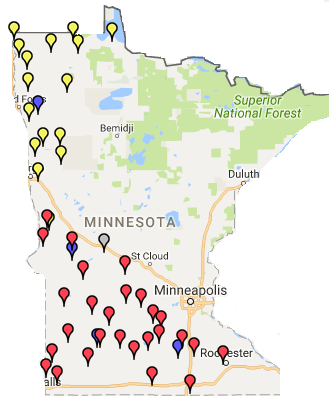
The MDA Six-Inch Soil Temperature Network provides real time soil temperatures at locations across the state and is maintained by the MDA. The network was established to assist in following best management practices (BMPs) for fall nitrogen fertilizer application which refer to a soil temperature at a six-inch depth (6 inch soil temp).
In areas of the state where fall nitrogen fertilizer application is appropriate, Minnesota's nitrogen BMPs recommend the fall application of urea (46-0-0) and anhydrous ammonia (82-0-0) be delayed until soil temperatures at a six-inch depth stabilize below 50 degrees Fahrenheit (F). The University of Minnesota Extension also recommends the same temperature delay for fall manure application to minimize leaching losses.
Ammonia (NH3) is one of the primary forms of nitrogen applied in the fall. It reacts immediately upon contact with soil water to form ammonium which binds tightly to the soil. Soil microbes transform ammonium to nitrate, which is highly mobile with water and can leach from the soil. This transformation is reduced when soil temperatures are below 50 degrees F. By delaying application, more nitrogen is available to the crop the following growing season. Leached nitrate can travel to groundwater and cause an increase in nitrate levels. Unfortunately, this has led to elevated nitrate levels in drinking water wells. Wells have exceeded the state's drinking water standard of 10 mg/L in several areas of the state. The Groundwater Protection Rule restricts the fall application of nitrogen fertilizer in areas with vulnerable groundwater. View the interactive Vulnerable Groundwater Area Map to learn more.
The MDA is responsible for the development, promotion and evaluation of BMPs for pesticide and nitrogen fertilizer use. The Six-Inch Soil Temperature Network helps meet that responsibility. It is a cooperative effort between the Minnesota Department of Natural Resources (DNR) and the MDA. The Six-Inch Soil Temperature Network sites are co-located at DNR cooperative stream gauging sites. The MDA installed soil temperature probes are connected to DNR data logging systems and every 15 minutes current data from this equipment is loaded onto this interactive map. The soil temperature sensors are placed in soil conditions similar to a crop field with a medium amount of residue cover.
Other Sources of Minnesota Soil Temperature Information
Four-inch soil temperature information from the University of Minnesota Research and Outreach Centers and the North Dakota Ag Weather Network (NDAWN) are also provided as supplemental soil temperature data in areas of Minnesota where six-inch reporting locations do not exist. Four-inch soil temperatures are more reactive to changes in air temperature and solar heating than six-inch soil temperatures, but they can still be a useful aid to estimate when the soil cools to 50 degrees F at a six-inch depth.
In southeast Minnesota the BMPs do not recommend fall application of nitrogen fertilizer at any time due to the high leaching potential. There are however, soil temperature sites on the map in this region. The soil temperature sites are included to assist in the timing of fall manure applications, which like nitrogen fertilizer, are best done after soil cools to under 50 degrees F.
Cooperators
Other Soil Temperatures
Soil temperatures in Minnesota
- Southwest Research & Outreach Center
- Southern Research & Outreach Center
- West Central Research & Outreach Center

