
-
 Spongy moth larvae found under flowerpot rim.
 -
 Spongy moth caterpillars (larvae) on cooler.
 -
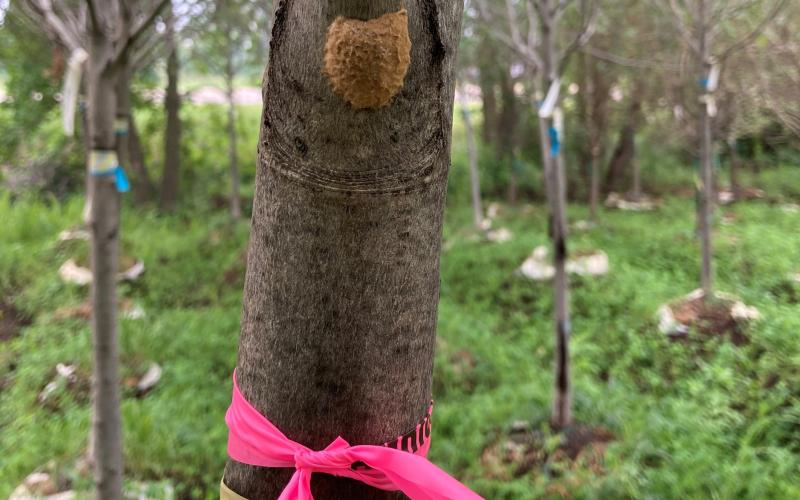 Spongy Moth egg mass on tree.
 -
 Spongy moth egg mass found on flowerpot.
 -
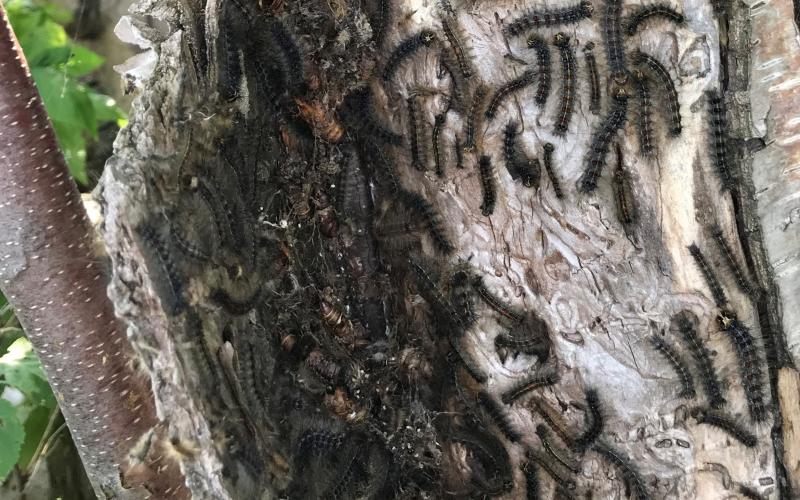 Spongy moth caterpillars (larvae) on tree.
 -
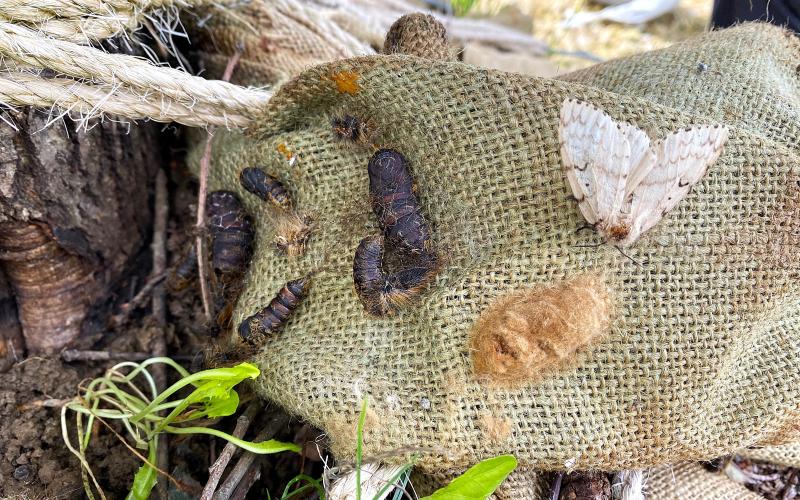 Female spongy moth, egg mass, and cocoons (pupae) on burlap.
 -
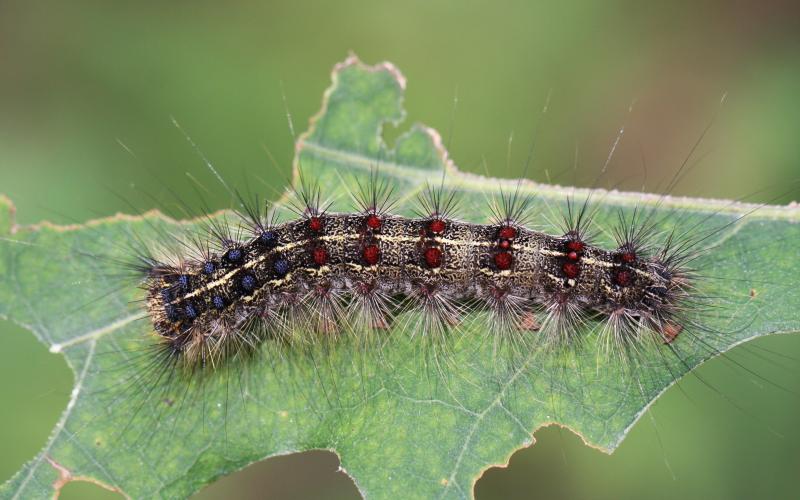 Spongy moth caterpillar (larva).
 -
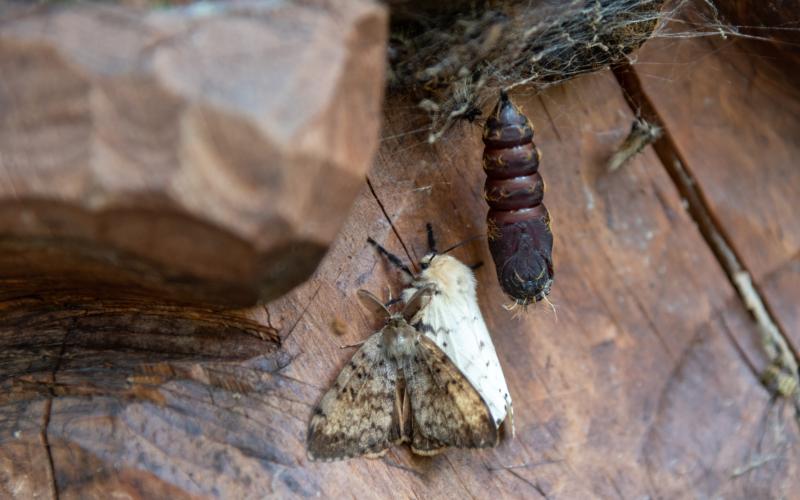 Male spongy moth, female spongy moth, and pupa (cocoon).
 -
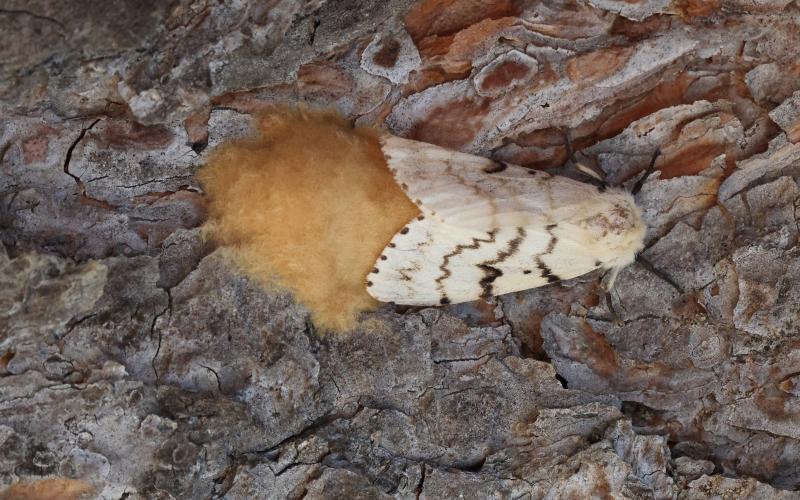 Female spongy moth with egg mass.
Return to spongy moth main menu
Spongy Moth Quarantine and Regulatory Information
Spongy moth is a serious, federally regulated invasive forest pest that requires a quarantine to prevent the spread and introduction into uninfested areas. Quarantines are used to limit the spread of invasive forest pests into new areas by preventing the unintentional movement of its life stages. The spongy moth quarantine limits the movement of certain items out of a designated area and is an effective tool for managing and slowing its spread across the United States and Minnesota.
Spongy moths are expert hitchhikers and are commonly transported as egg masses. Females lay eggs on any solid surface, increasing the risk of spread.
Emergency Temporary Quarantines
(Cities of Coon Rapids, and Maplewood)
Due to delays and uncertainty with federal funding, proposed Bacillus thuringiensis var. kurstaki (Btk) treatments for 2026 were canceled. Consequently, the Minnesota Department of Agriculture (MDA) implemented emergency spongy moth quarantines in May 2025 in designated areas of Coon Rapids.
Based on 2025 survey results, the MDA has modified and extended the quarantine through June 30, 2027, for designated areas in Coon Rapids with a reduction in overall quarantined acreage.
A new quarantine has been established for Maplewood following confirmation of a newly introduced, isolated population, evidenced by the presence of male and female moths and egg masses. View the spongy moth quarantine map.
The following articles are regulated and cannot be moved outside the emergency quarantine area in each city:
- Spongy moth in any stage of development: eggs, larvae, pupae, or adult moths.
- Trees and shrubs with roots and persistent woody stems, unless they are greenhouse grown throughout the year.
- Firewood, logs, limbs, and branches over four inches in diameter. All species of ash (Fraxinus) are excluded.
- Any other outdoor household articles, such as:
- Outdoor furniture
- Dog houses
- Flower pots
- Tents
- Awnings
- Boats
- Trailers
- Recreational vehicles
These items are regulated if an inspector determines there is a high risk of infestation.
Formal Quarantines
(Cook and Lake Counties)
Cook and Lake counties have permanent, established spongy moth populations, and therefore have formal quarantines in place. The following articles are regulated under formal spongy moth quarantines in both Cook and Lake counties:
- All stages of the spongy moth life cycle, including eggs, larvae, pupae, and adult moths
- Logs, posts, sawbolts, and pulpwood
- Bark and bark products
- Nursery stock
- Christmas trees, boughs, wreaths, and garlands
- Firewood
- Outdoor household items
- Mobile homes and associated items
- Any other products, articles, or means of conveyance deemed high-risk for spreading spongy moth
Industry Guidelines
 Nursery stock
 Christmas Trees
 Logs, Posts, Pulpwood, Bark and Bark Products
Shippers operating under a compliance agreement must document all loads leaving the quarantine and specify the destination. Treat or remove any life stages found upon inspection. Receivers of quarantined products must operate under a compliance agreement and follow the guidelines for processing procedures.
Emergency Quarantine FAQs
An emergency quarantine is a restriction on the movement of spongy moth life stages and materials from leaving the designated emergency quarantine area. The Minnesota Department of Agriculture (MDA) emergency quarantine will be in effect from May 1, 2025 to June 15, 2026.
Due to federal budget uncertainties and significant funding delays within the USDA Forest Service, the MDA did not receive the federal funding needed in time to perform Btk aerial management operations. This has forced the MDA to cancel all Btk management for 2025, which was proposed in areas with high-risk spongy moth infestations. Btk targets and kills spongy moth caterpillars.
As a result, the MDA is placing an emergency quarantine in these areas to prevent the spread of spongy moth. The MDA will intensely survey these areas in 2025 with hopes to manage in 2026.
The emergency quarantine restricts movement of all regulated articles outside of the emergency quarantine zone until the emergency quarantine is lifted. Residents living within the emergency quarantine area must self-inspect any regulated articles. The following is a list of examples of items that should be inspected:
- Lawn and garden equipment
- Outdoor household and patio items
- Recreational vehicles (RVs, campers, ATVs, etc.)
Trees may be pruned but all branches, woodchips and other woody material must stay on the property. Tree bark and branches have the highest risk of having egg masses attached. The emergency quarantine also requires that all outdoor household products, such as patio furniture, trucks, campers, or pallets be inspected to assure the article is free of spongy moth life stages before moving them out of the emergency quarantine zone.
Spongy Moth Quarantine Limited Permit FAQs
All untreated regulated articles, such as sawbolts, pulpwood, or bark for fuel, must be accompanied by a limited permit when leaving spongy moth quarantined areas. Untreated regulated articles can only be transported to specified locations in accordance with specialized conditions.
Limited permits cannot be used for shipment of sawlogs, firewood, bark for mulch, holiday greenery, nursery stock, or for movement outside of Minnesota.
Limited permits expire annually on April 30. Contact the MDA if you need a limited permit after April 30 for the 2026 calendar year.
To obtain a limited permit, individuals must complete a training provided by the MDA. If you had a valid 2025 limited permit you will be emailed instructions on the 2026 training and renewal application. All MDA limited permits expire annually on April 30.
Online training is available by following the steps below.
- Complete the application form.
- Submit your application by email to the MDA.
- Watch the MDA training video.
- Complete an online quiz.
Your limited permit will be emailed to you after completing the four steps above in 7-10 business days. If you have questions, please contact the MDA at christopher.mallet@state.mn.us.
Compliance Agreement FAQs
A compliance agreement is a formal agreement between the state and an entity who handle or move regulated articles out of an emergency quarantine. Compliance agreements establish standard operating procedures that meet the emergency quarantine requirements to limit the risk of spreading spongy moth. Any entities that regularly handle or move regulated articles within and outside the emergency quarantine areas are encouraged to enter into a compliance agreement with the MDA. More information can be found on the Pest Regulations webpage. To establish a compliance agreement, call 651-201-6329.
Quarantine violations occur when companies or individuals transport regulated articles out of the quarantined area without appropriate documentation. This can result in civil or criminal penalties. Entities that regularly move regulated articles can continue to do so if they are operating under a compliance agreement.
Smarty Plants Podcast
Discover Smarty Plants, the Minnesota Department of Agriculture's podcast that digs into the fascinating world of invasive species. Join expert guests as they share insights and solutions to protect our environment and agricultural resources. Visit Smarty Plants and start listening today.

