
-
 Spongy moth eggs are laid in a fuzzy, tan-colored mass.
 -
 Spongy moth egg mass with newly hatched caterpillars. Photo by Bill McNee, Wisconsin Dept of Natural Resources, Bugwood.org.
 -
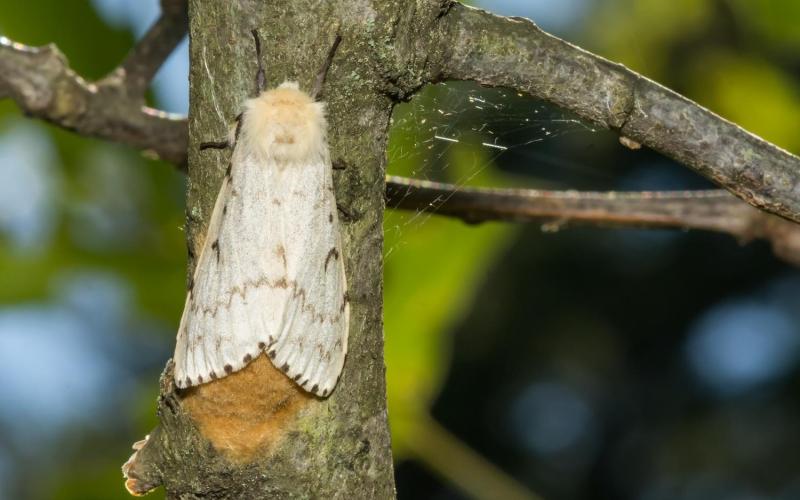 Female spongy moth with egg mass.
 -
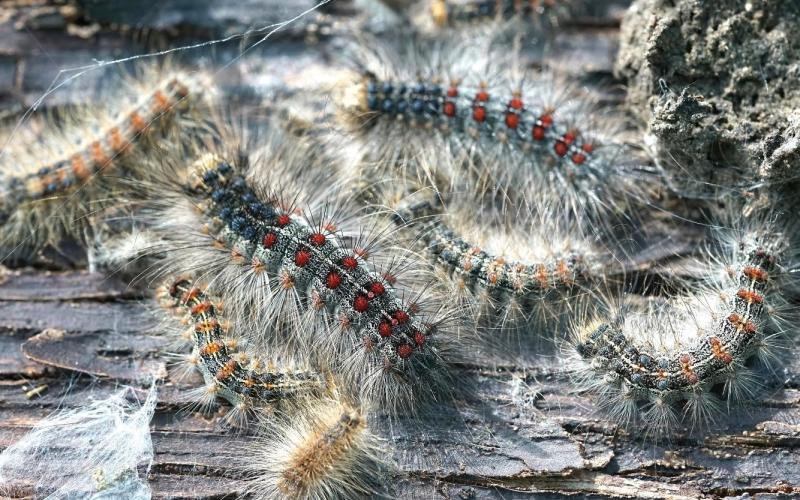 Spongy moth caterpillars, or larvae, have five pairs of blue spots near the head, followed by six pairs of red spots.
 -
 Spongy moth pupa (cocoon) can range in size from three-fourths of an inch to 1 1/2 inches long. Photo by Jim Occi, BugPics, Bugwood.org.
 -
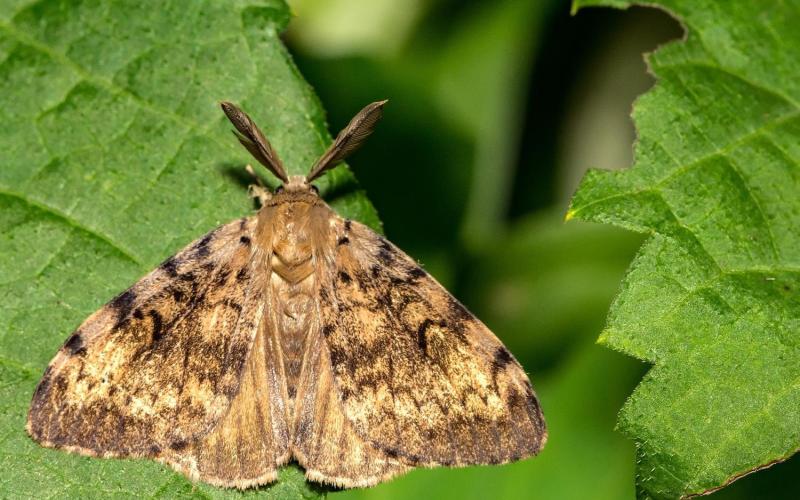 Male spongy moth.
 -
 Female spongy moth.
Return to spongy moth main menu
Spongy Moth
Scientific name: Lymantria dispar
Native range: southern Europe, northern Africa, central and southern Asia, Japan
At Risk
The spongy moth can eat the leaves of over 300 species of trees and shrubs. The spongy moth prefers broad-leaf deciduous trees, but can also defoliate evergreen trees. Defoliation usually does not kill trees directly, but the added stress makes trees susceptible to other things that can cause death. For example, the two-lined chestnut borer (Agrilus bilineatus) and shoestring root rot (Armillaria spp.) can cause mortality on stressed trees.
Spongy moth lay their eggs in protected areas on both natural and artificial surfaces. Egg masses are the overwintering life stage and are the life stage that is present for the longest amount of time (approximately 10 months in Minnesota). Their ability to lay their egg massed in hidden areas makes the spongy moth an expert hitchhiker. When visiting a spongy moth quarantined area, be sure that you give all outdoor articles a thorough inspection for egg masses before leaving the area.
Pest Status
The spongy moth is regulated federally and in the state of Minnesota. Lake and Cook counties are quarantined for spongy moth. For more information visit the USDA’s interactive spongy moth quarantine map.
Distribution
Spongy moth was introduced to the United States and Canada in 1869, and has since spread across much of the northeastern U.S. For more information visit the Slow the Spread website.
Minnesota-Milestones for Spongy Moth
1969: First signs of spongy moth appear in Duluth (egg masses and pupal cases)
1973: Annual trapping program begins with 550 traps set
1976: First male moth trapped in the state (Hennepin County)
1980: First isolated spongy moth infestation, St. Paul Minnesota. Insecticide applications eradicated the insect from the site.
2004: Minnesota joins the national Spongy Moth Slow the Spread program.
2014: Cook and Lake Counties become quarantined due to the presence of reproducing populations
Biology

This chart shows the average developmental times for spongy moth in Minnesota. The length of each life stage depends on weather conditions, which vary annually.
What Can I Do?
Contact the Minnesota Department of Agriculture via Report A Pest or by sending an email to reportapest@state.mn.us if you suspect you have found spongy moth.
Spongy Moth Identification FAQ
It is still rare to find spongy moth in Minnesota, usually the only way they are detected is when lured into survey traps. Other species more commonly found in Minnesota, such as the Forest and Eastern Tent Caterpillars, can be similar looking to spongy moth.
Spongy moth eggs are laid in a fuzzy, tan-colored mass. The egg mass contains 500-1,000 eggs and is about the size of a quarter. Eggs are laid during late summer and hatch the following spring. Egg masses can be found on both living and inanimate objects, including:
- nursery stock
- logs
- roof eaves
- wheel wells
- firewood
- lawn chairs
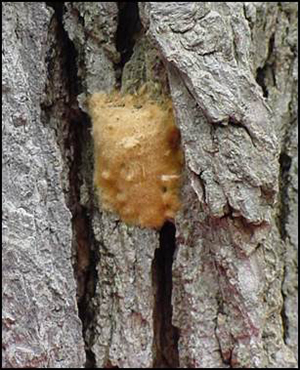 Egg mass
This is the life stage that is most likely to be transported by humans.
The caterpillar hatches from the egg and grows to a length of 2½ inches as it matures. Its body is covered with hairs to protect it from predators. Along its back, the caterpillar has five pairs of blue spots near the head followed by six pairs of red spots. It actively feeds on plant foliage from late spring through mid-summer.
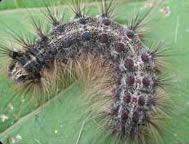
Caterpillar (larva)
The pupa is an immobile stage of this insect's life. Though it appears inactive, it is very busy inside transforming from a caterpillar into an adult moth. Found during mid-summer, it is dark reddish-brown, leathery in appearance, and often tethered to an object with silk strands. Pupae can range in size from ¾ inch to 1½ inches long.
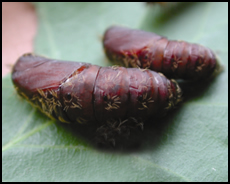 Pupa
Pupa
The adult female moth is white with brown jagged markings on her wings. Her wingspread ranges from 1 to 2 inches, but she cannot fly. Female spongy moth attracts males by releasing a pungent sex attractant (pheromone). After attracting a male and successfully mating the female lays a single egg mass and dies. Adult moths are typically active from late summer through early fall.
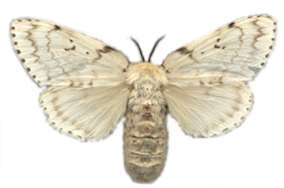 Adult Female
The adult male moth has feathery (plumed) antennae that are so sensitive they can "smell" a female a mile away. His body can be light beige to dark brown with black jagged bands on brown forewings. His wingspread ranges from only ¾ to 1½ inches, he is a strong flyer and capable of mating with several females. Adult moths are typically active from late summer through early fall.
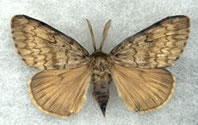 Adult Male
Smarty Plants Podcast

Subscribe to Smarty Plants, the Minnesota Department of Agriculture's podcast that digs into the fascinating world of invasive species. Join expert guests as they share insights and solutions to protect our environment and agricultural resources.
Plant Pest Insider

Subscribe to the Plant Pest Insider, the MDA's monthly newsletter. Receive updates on pest management, new detections, and ways to help protect Minnesota’s plants and environment.

